
Fast Reading
- Private aviation works best when it solves a clear travel problem: fewer connection risks, better access to smaller airports, more privacy and certain same-day trips that commercial travel cannot easily support.
- The right access model depends on how someone actually travels. Light or changing use may fit charter or membership, while more predictable travel may support a jet card, lease, fractional ownership or, in limited cases, whole-aircraft ownership.
- Buyers should avoid overcommitting before their travel needs are clear and should diligence providers carefully, including safety standards, operating control, pricing transparency, recovery plans, contract terms, documentation and deposit exposure.
Private aviation can materially improve travel when the mission justifies it. It can reduce connection risk, expand access to smaller airports and make certain itineraries possible in a single day that commercial service would turn into two. For many travelers, the value lies in schedule control, privacy and the ability to fly closer to the final destination.
But private aviation is not a single product, and it does not remove every source of travel friction. Weather, maintenance events, crew-duty limits and airport constraints still matter. What private aviation offers is a different level of control over the trip, not immunity from operational reality.
It is also a spectrum of access models, from on-demand charter and membership programs to jet cards, leases, fractional ownership and whole-aircraft ownership. Each comes with different economics, service terms, operational control and counterparty risk.
For that reason, the best decisions rarely begin with the question, “Can we fly private?” A better starting point is, “What problem are we trying to solve, how often does it occur and what level of access solves it without unnecessary cost, commitment or complexity?”
This guide is designed to help readers answer that question in two steps: first, by right-sizing the access model to the mission; and second, by selecting a provider whose operating model, economics and risk profile align with that mission.
Personal and Business Flyers: Similar Aircraft, Different Scorecards
A useful early distinction in private aviation is that the aircraft may be similar, but the scorecard usually is not. Broadly speaking, buyers tend to fall into two groups: personal flyers and business flyers.
They may use the same aircraft categories and even the same providers, but they should not evaluate those choices in the same way.
For personal flyers, private aviation is usually a lifestyle decision. The value is measured less in direct financial return than in time recovered, stress avoided and flexibility gained. A personal flyer may put heavy weight on convenience, such as the ability to schedule a same-day round trip that would otherwise require an overnight stay, direct access to a smaller airport near a second home or resort destination, or the ability to move a family on a schedule that commercial service does not support.
The most common mistake for personal flyers is overcommitting before their actual travel pattern is clear. Large prepaid balances, multi-year contracts and oversized aircraft can feel attractive at the outset, but they reduce flexibility precisely when a buyer is still learning how they will use the service in practice. For that reason, preserving optionality is often more valuable than chasing the lowest headline hourly rate.
Business flyers typically evaluate private aviation differently. Their focus is more likely to be productivity, reliability, passenger safety, executive security and the ability to support time-sensitive travel that commercial service serves poorly.
In the business context, the most common mistake is assuming that higher utilization or ownership will automatically produce attractive economics or favorable tax outcomes. In reality, those outcomes depend on legal structure, tax treatment, recordkeeping requirements and policy discipline. Business users should expect to maintain clear trip-purpose records, passenger logs, detailed invoices, operator information and policies governing personal use. Documentation readiness should be treated as part of the operating model, not as an administrative afterthought.
Right-Sizing Access: Matching the Mission to the Model
Once the nature of the flying, whether personal, business or a combination of both, is clear, the next step is to right-size the level of access. The objective is not to find the "best" program in the abstract, but to match the way one actually travels to a model that fits without an overcommitment of capital or undue complexity.
At the center of this analysis is the “mission profile.” This profile includes where flights typically originate and terminate, how often travel occurs, how many people usually travel together and how much advance notice is available. These factors, more than brand names or aircraft specifications, should drive the decision.
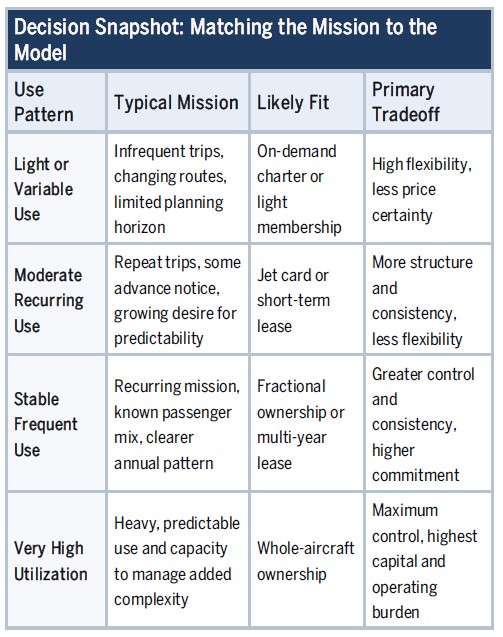
Other filters: passenger count and baggage profile, airport and runway constraints, lead time and seasonality and counterparty risk.
Annual flight volume is usually the clearest starting point, but it should not be viewed in isolation. Lighter or less predictable use often favors on-demand charter or light membership programs because they preserve flexibility and limit capital at risk. As travel becomes more frequent, jet cards, leases or fractional programs can offer greater consistency. Whole-aircraft ownership is compelling only when utilization is high, travel patterns are stable and the organization is prepared to take on more complexity.
Passenger count and baggage needs also matter because they influence aircraft size and category. Geography matters as well: runway length, airport availability and regional weather patterns can shape which aircraft types and providers are realistic. Lead time and seasonality further complicate the picture.
Travelers who plan well in advance and fly off-peak often enjoy better availability than those who need short-notice access during high-demand periods.
Finally, preferences and risk considerations should not be overlooked. Aircraft age, cabin configuration, brand consistency and service model all affect the experience. Counterparty risk matters as well, especially when deposits or prepaid balances are involved. Understanding where funds sit, how they are protected and under what conditions they can be returned is essential.
Selecting the Right Provider: Where Experience Diverges
Once the access model is clear, provider selection becomes the primary differentiator. Two clients can purchase a similar amount of access and have dramatically different experiences depending on who operates the aircraft, how availability is managed and how transparently costs are disclosed.
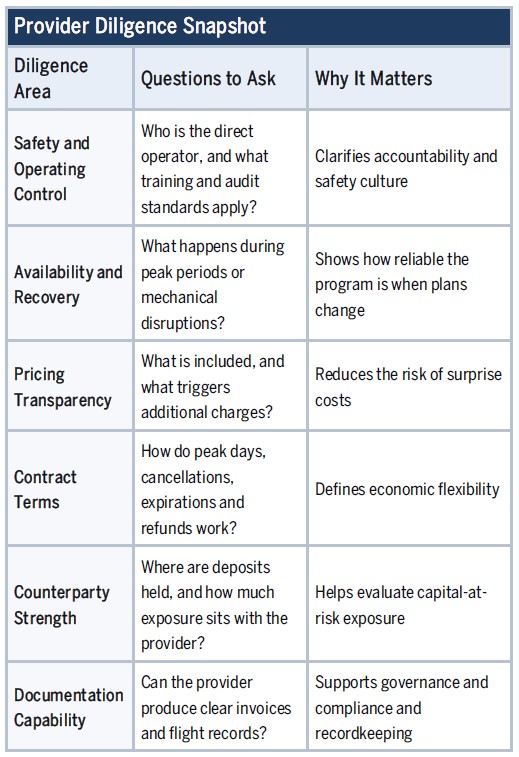
Private aviation providers generally fall into several broad categories. Fleet-based operators, such as fractional ownership, lease or card programs, often offer the most consistent experience because they control aircraft and crews directly, though they usually require higher commitments. Membership and pay-as-you-go programs can provide a lower-commitment entry point, while brokerage and logistics platforms source aircraft from third-party operators. Local charter operators can be effective near a home airport, and management companies add structure to owned aircraft operations.
Across categories, the same principle holds: the client experience is shaped less by marketing language than by operational control, contract design and how the provider performs when plans change. For business flyers, documentation capability is another critical differentiator. Providers should be able to produce clear invoices, aircraft identifiers, operator information and flight records that support internal governance and substantiation requirements.
Ownership Considerations: Governance Before Glamour
In some cases, usually where utilization is both high and predictable, aircraft ownership enters the conversation. When it does, the discussion should extend well beyond the acquisition price or the aircraft itself. Whole ownership is not simply a transportation choice; it is the assumption of a small operating enterprise, whether that enterprise is managed internally or overseen through outside specialists.
Ownership introduces a different level of governance, compliance and execution risk. In addition to capital committed to the aircraft, buyers must think about crew hiring and retention, maintenance planning, unscheduled downtime, hangar and logistics arrangements, insurance, management-company oversight and eventual resale or liquidity risk.
From a tax, regulatory and governance perspective, outcomes depend on business-use allocation, rigorous substantiation and clearly administered policies around personal use. Even when structured well, ownership is still the highest-commitment path in private aviation.
For international clients, private aviation regulations, tax treatment, ownership structures and operating practices vary by country. Appropriate legal, tax and aviation advice should be sought in all relevant jurisdictions.
For many clients, that is exactly why fractional ownership, lease structures or well-designed access programs can be attractive. They often capture much of the scheduling and productivity benefit of private aviation while reducing the capital at risk and the operational burden of direct ownership.
What Private Aviation Does Not Solve
Private aviation can improve control over a trip, but it does not eliminate operational reality. Weather still disrupts flying. Aircraft still experience maintenance events. Crews remain subject to duty and rest requirements. Airport slots, customs immigration and border-control procedures, sabotage restrictions and runway constraints still apply. Buyers who understand those limits up front tend to make better decisions about both access model and provider selection.
Closing Perspective
Private aviation is most valuable when treated as a tool rather than an identity purchase. For personal flyers, that usually means buying enough flexibility to reduce friction without locking in more commitment than the travel pattern supports. For business flyers, it means pairing access with documentation, policy discipline and a provider that can perform reliably under operational pressure.
The best outcomes usually come from three decisions made in the right order: define the mission clearly, choose the lightest access structure that can support that mission reliably and diligence the provider behind it with the same seriousness applied to any other meaningful service relationship.
Done well, private aviation can increase control over time, expand what is practical in a single day and reduce the inefficiencies of commercial travel. Done poorly, it can create avoidable cost, complexity and counterparty exposure. The goal is not simply to fly private; it is to solve the travel problem in the cleanest and most durable way.
Our role as Strategic Advisors is to help translate the complexity of a flyer’s needs and constraints into clear, practical decisions so that private aviation enhances flexibility and control rather than creating new risks or surprises. We are always here as a sounding board for these types of considerations and questions so that you can feel confident in your travel options. 
The views expressed are those of Brown Advisory as of the date referenced and are subject to change at any time. This material is provided for informational purposes only and is not individually tailored to, or directed at, any particular client or prospective client.
Private aviation involves significant costs, risks, and limitations, including those discussed herein. These considerations are highly fact-specific and may vary based on ownership structure, aircraft usage, business versus personal use, financing, regulatory requirements, insurance coverage, operational arrangements, and a client’s or prospective client’s broader financial, estate planning, and tax circumstances. This material does not constitute a recommendation, offer, or solicitation to purchase, lease, charter, finance, or invest in any aircraft, aviation program, fractional interest, jet card, security, fund, product, or service. Brown Advisory does not render legal, tax, accounting, aviation, insurance, or other specialized professional advice. Prior to making any investment, planning, structuring, financing, ownership, leasing, chartering, or other decision discussed herein, clients and prospective clients should consult with their own legal, tax, accounting, aviation, insurance, and other advisers to determine the potential benefits, burdens, risks, and consequences of any such decision.