
Fast Reading
- A low valuation is a starting point, not an answer. It narrows the field, while underwriting determines whether the market has mispriced risk or correctly identified permanent impairment.
- Behaviour can create opportunity, but it cannot validate an investment thesis. We differ from consensus only when the evidence suggests price has overreacted relative to fundamentals.
- Portfolio construction is part of underwriting. It helps ensure that individual ideas do not combine into an unintended concentration in the same underlying risk.
Every deep value idea starts as a number on a screen. Very few of them should end there.
Low valuations can be useful signals, but they are rarely complete answers. They often appear where expectations are subdued, uncertainty is elevated or investor attention has shifted elsewhere. These conditions can create opportunity, but they can also point to genuine impairment.
Deep value begins in that tension. Price provides the starting point. Underwriting determines whether the opportunity has investment merit. The discipline lies in distinguishing uncertainty that may create mispricing from risks that could permanently impair value, while understanding what is already reflected in the valuation and whether potential downside can be assessed with sufficient confidence before capital is committed.
This article brings together recent discussions on AI-related disruption and the behavioural risk of selling improving investments too early, placing both within the broader deep value process and the investment judgement that connects valuation, underwriting and portfolio construction.
Price as the starting point
The price paid can be an important determinant of long-term return potential and shapes the balance between risk and reward. Yet a low price has limited value without deeper underwriting. Our work begins by assessing what the market appears to be discounting and whether the evidence supports a wider range of potential outcomes.
Brown Advisory’s broader value framework has long emphasised free cash flow, capital discipline and valuation. Our process expresses those principles through an explicitly behavioural deep value lens. We begin with valuation screens focused on the cheapest third of the investable universe, then apply judgement through pain mapping, normalised five-year analysis, formal risk scoring and portfolio construction.
The screen is deliberately only the beginning. It directs attention toward securities where expectations are already low, but it does not tell us whether those expectations are wrong.
We ask practical questions. What is the business worth on a normalised view? What could cause permanent loss of capital? What is already reflected in the share price? What evidence would cause us to change our view? And what would have to improve for the market to reassess its conclusion?
For that reason, the approach is better understood as a repeatable research process than as a low-multiple screen, a macro call or a generalised bet that unpopular areas of the market will recover.
Mispricing or impairment?
That distinction sits at the centre of the underwriting process. Cheap securities often look similar on a screen, but the reasons they are cheap can be very different. Some businesses face temporary pressure, misunderstood cash flows or uncertainty that the market has extrapolated too far. Others face structural change, deteriorating economics, weak balance sheets or poor capital allocation that permanently reduces their value.
Our objective is to identify situations where the downside can be underwritten and the potential return is attractive relative to the risks we can see. If the evidence does not support that balance, a low valuation is not a reason to own the stock. It may simply be a deserved discount.
In Practice: When cheap stops being enough1
Take Builders FirstSource and Mohawk Industries. Both still looked inexpensive on some measures, but when we revisited the assumptions behind the original investment cases, the balance of risk and return had changed.
For Builders FirstSource, we became less comfortable with the combination of normalised margins, housing-cycle exposure and the capital structure. For Mohawk, taking a more conservative view of the valuation the business might command reduced our estimate of prospective return. In both cases, we sold the holdings because the potential upside no longer compensated us for the risks we were underwriting.
Neither holding needed to become expensive for the investment case to change. In both cases, updated assumptions altered the balance between prospective return and the risks we were taking.
That is an important part of the discipline. Cheapness can get a stock onto the screen, but it cannot keep it in the portfolio. As the evidence changes, the investment case must be rebuilt.
This is why we focus on permanent loss of capital rather than short-term price volatility. A falling share price provides new information to assess, while impairment depends on whether the underlying circumstances permanently reduce the value of the business.
Before an investment is made, we assess balance-sheet resilience, liquidity, governance, currency exposure, country risk, macro sensitivity, thematic correlation and expected return. Together, these shape our view of whether a low valuation reflects opportunity or a deserved discount. A low valuation may represent an investment opportunity when the risks embedded in the discount can be understood and the potential return justifies taking them.
A stock does not become a value trap simply because it remains unpopular for longer than expected. A value trap arises when the apparent discount no longer adequately compensates for the risk of permanent impairment, poor capital allocation, excessive leverage or when there is no credible path to value realisation.
The same test applies to disruption. In our recent article on artificial intelligence, we considered businesses widely assumed to be vulnerable, where the available evidence suggested that AI could reinforce rather than erode their economics. Earnings may appear temporarily depressed, assets or cash flows may be misunderstood, or capital returns may receive limited recognition. In each case, the work is to determine whether the market has priced uncertainty as if it were permanent impairment.
Behaviour creates the opportunity
Across the Global Value Select and International Value Select strategies, we have described value as, first and foremost, a behavioural phenomenon. Market prices can reflect fundamentals, but they can also reflect investors’ emotional response to uncertainty, loss and change. In our view, value investing persists because human nature does not change.
Fear, loss aversion, extrapolation and career risk can influence selling behaviour, especially when prices fall and negative narratives become dominant. In those moments, investors may prioritise avoiding further pain over re-underwriting intrinsic value. They may overestimate the pace of change in the short term and underestimate its significance over the long term.
But behavioural analysis is only an explanation for why mispricing may exist. Many stocks fall for valid reasons, and the market remains a sophisticated discounting mechanism. Our aim is not to be contrarian for its own sake. We differ from consensus only when the evidence suggests price has overreacted relative to fundamentals. Behaviour may explain why a discount exists. Underwriting tests whether the fundamentals support taking the risk.
The same discipline must apply internally. A process that studies behavioural errors in the market also needs mechanisms to guard against them in ourselves. We use structured prompts, including pain mapping, momentum highlights, upside capture reviews2 and after-action analysis to interrupt the moments when investors are most likely to become anchored, defensive or impatient.
In Practice: When a rising share price is not a sell signal
Value investors can become uncomfortable when a holding rises sharply. The instinct can be to take the gain and move on.
We have seen that tension in our managed-care holdings. As share prices recovered, our Upside Capture Review prompted us to reassess the companies from first principles. In this case, the underlying evidence had improved alongside the prices. Rather than automatically reducing the positions, the review gave us greater confidence in parts of the opportunity.
Investment decisions should remain grounded in the underlying case, with price movement treated as one piece of evidence.
Portfolio construction makes risk intentional
Deep value opportunities are often hidden in plain sight. Large, well-known companies, sectors or regions can remain deeply disliked when investors anchor on a negative narrative for too long. The opportunity arises when the market’s memory of past losses, fear of disruption or discomfort with uncertainty overwhelms improving fundamentals and current evidence. The skill is to identify where that disconnect creates genuine value, rather than simply buying what the market dislikes.
The underwriting process does not end when a stock is approved. A portfolio is not a collection of standalone bargains. It should reflect a balanced set of intentional risks, sized by conviction, prospective return and diversified across underlying drivers that could cause those investments to succeed or fail.
Those drivers often cut across conventional sector and country classifications. Payments, software and staffing businesses may sit in different sectors, but if all are marked down because investors believe they are vulnerable to AI-related disruption, the portfolio can contain one large underlying bet. Iron ore miners, car manufacturers and luxury goods companies may all reflect the same concern about a weaker Chinese consumer. Sector diversification alone may not capture that risk.
We therefore assess portfolio-level risk through both conventional and modern lenses. We also examine thematic exposure, emerging correlations, IRR decomposition, cycle understanding and revenue drivers. Our objective is not to eliminate uncertainty, but to assess whether it is understood, appropriately priced and diversified, and whether apparently different holdings ultimately rely on the same underlying risk or narrative. Exhibit I sets out the lenses we use to assess portfolio-level risk alongside the conventional ones.
Exhibit I. How we assess portfolio-level risk
Portfolio-level risk analysis is intended to support diversification across common drivers, not only across sectors and regions.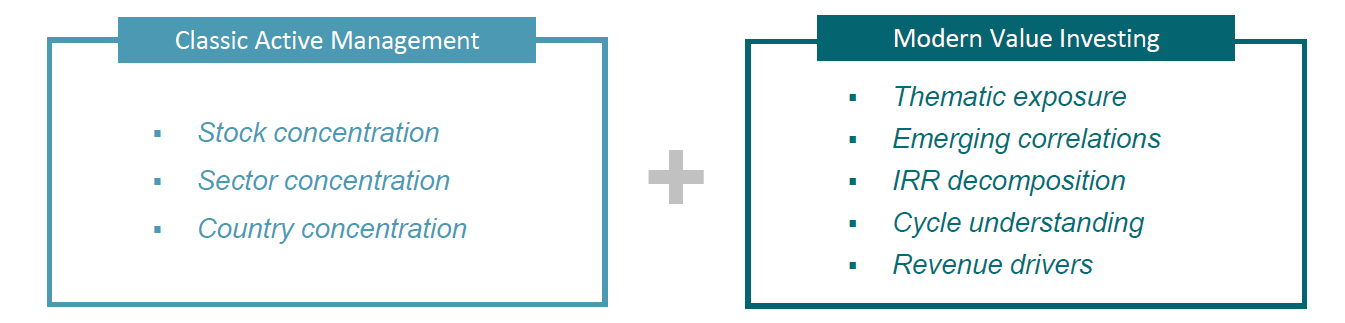
Source: Brown Advisory.
When price becomes opportunity
Deep value often begins where consensus is sceptical and investor attention has narrowed. Across our process, valuation narrows the field, but underwriting determines what is investable. Behavioural insight helps explain why the opportunity may exist. Fundamental research tests whether that discount is justified. Portfolio construction helps determine whether the resulting risks can be owned deliberately alongside the rest of the portfolio.
Investor attention can cluster around a challenged sector, complex business model, governance concern, policy change, currency move or technological disruption. A broader investment universe gives us more places to apply the same discipline, but breadth itself is not the advantage. The advantage is a repeatable process for deciding which discounts are investable.
That is deep value as we practise it: valuation may identify the opening, but underwriting decides whether the opportunity belongs in the portfolio.
1. Source: FactSet®, as of 06/30/2026. The companies were held in the Brown Advisory Global Value Select strategy and were sold in Q2 2026. The portfolio information is based on a representative Global Value Select account.
2. The upside capture review process is a rules-based behavioral tool and does not guarantee improved outcomes. Adding to rising positions may increase portfolio concentration and loss exposure. A stock remaining in the cheapest valuation tier may reflect persistent fundamental deterioration rather than a market mispricing. Past effectiveness of this approach is not indicative of future results.
Disclosures
All investments involve risk, including possible loss of principal. Please see each product's web page for specific details regarding investment objective, risks, performance, and other important information. Review this information carefully before you make any investment decision.
The views expressed are those of the author and Brown Advisory as of the date referenced and are subject to change at any time based on market or other conditions. These views are not intended to be and should not be relied upon as investment advice and are not intended to be a forecast of future events or a guarantee of future results.
Past performance is not a guarantee of future performance, and you may not get back the amount invested.
The information provided in this material is not intended to be and should not be considered to be a recommendation or suggestion to engage in or refrain from a particular course of action or to make or hold any of the securities or funds mentioned. It should not be assumed that investments in such securities have been or will be profitable. To the extent that specific securities are mentioned, they have been selected by the author on an objective basis to illustrate views expressed in the commentary and do not represent all of the securities purchased, sold or recommended for advisory clients. This material is intended solely for our clients and prospective clients, is for informational purposes only and is not individually tailored for or directed to any particular client or prospective client.
The information contained herein has been prepared from sources believed reliable but is not guaranteed by us as to its timeliness or accuracy and is not a complete summary or statement of all available data. The information in this document has not been independently reviewed or audited by outside certified public accountants. The information provided is not intended to be a forecast of future events or a guarantee of future results. Past performance is not indicative of future performance.
Brown Advisory uses artificial intelligence (“AI”) tools to assist with analysing and summarising various data and information. All AI assisted outputs are reviewed and validated by the Brown Advisory Investment team, and these tools do not replace or inform the firm’s independent fundamental research or investment decision making. AI is not used to make investment decisions or manage any Brown Advisory fund or strategy.
Terms and Definitions:
The internal rate of return (IRR) is a measure of an investment’s rate of return. The internal rate of return is a discount rate that makes the net present value(NPV) of all cash flows from a particular project equal to zero. It is also called the discounted cash flow rate of return. Free Cash Flow (FCF) represents the cash a company generates after cash outflows to support operations and maintain its capital assets. Unlike earnings or net income, free cash flow is a measure of profitability that excludes the non-cash expenses of the income statement and includes spending on equipment and assets as well as changes in working capital. Valuation is the process of estimating or determining how much an asset, business, or property is worth in monetary terms. Capital discipline refers to the investment team’s process for evaluating whether a company’s prospective return continues to justify the risks associated with the investment.