
Fast Reading
- AI and data-center growth are contributing to rapidly changing electricity-demand expectations, while the infrastructure needed to serve new loads often develops on longer timelines.
- The energy outlook, particularly at the intersection of AI and power demand, is being reshaped by technological change, geopolitical events and physical constraints that are difficult to predict. That uncertainty reinforces the limits of precise long-term forecasts.
- For bottom-up investors, these pressures may create company-specific opportunities in efficiency, reliability and resource productivity across the energy system.
A year ago, we argued that the future of energy would not be defined by a simple choice between traditional and renewable sources. Rising demand, energy-security priorities and decarbonization goals pointed instead to investment across a broader ecosystem: additional supply, greater efficiency, stronger infrastructure and continued innovation.1
The backdrop has changed materially over the past 12 months. Electricity-demand expectations have accelerated, data centers have become an important source of U.S. load growth and geopolitical disruption has again exposed energy markets’ sensitivity to unpredictable events.2, 3
In their recent publication, Energy Resilience Meets AI, our colleagues explored how AI-driven electricity demand and geopolitical disruption are underscoring the need for a resilient energy system—and creating opportunities for companies that can make it more secure, efficient and reliable.4 These pressures extend beyond energy. Infrastructure and natural-resource bottlenecks increasingly influence where growth can occur, how much it costs and where new investment opportunities may emerge.
As a result, the physical energy system has become more central to the investment case. New generation is useful only if it can be permitted, financed and connected to the grid; serving large new loads may also require transmission and other infrastructure to be built first. The Federal Energy Regulatory Commission (FERC) has noted that increasingly large data centers may require new generation or transmission infrastructure to interconnect reliably, even as large-load customers seek faster connections.5
The result is a timing mismatch: demand can grow faster than usable capacity can respond. Meeting that demand will require substantial investment in generation and infrastructure across a diverse range of technologies. Scarcity can also increase the value of using existing assets more productively. Because much of the grid was built decades ago, opportunities include moving more electricity through existing infrastructure, reducing conversion losses, improving generation productivity and using constrained resources more efficiently.
Demand is rising, but capacity is the constraint
For many AI infrastructure projects, three physical constraints increasingly intersect: power, grid capacity and water. Power-hungry computing requires large amounts of electricity to be generated and delivered to the site. That computation also produces substantial heat, creating additional demand for cooling, which itself can require electricity and water. The economics of AI infrastructure therefore depends on the availability and cost of physical infrastructure and resources at a given location. The scale of expected demand helps explain why these constraints are becoming more acute. The International Energy Agency’s (IEA's) central case sees global total data-center electricity consumption roughly doubling from 485 terawatt-hours (TWh) in 2025 to 950 TWh in 2030, albeit with substantial uncertainty around the path of that growth.6
CHART 1: DATA CENTER ELECTRICITY CONSUMPTION (2020-2030)
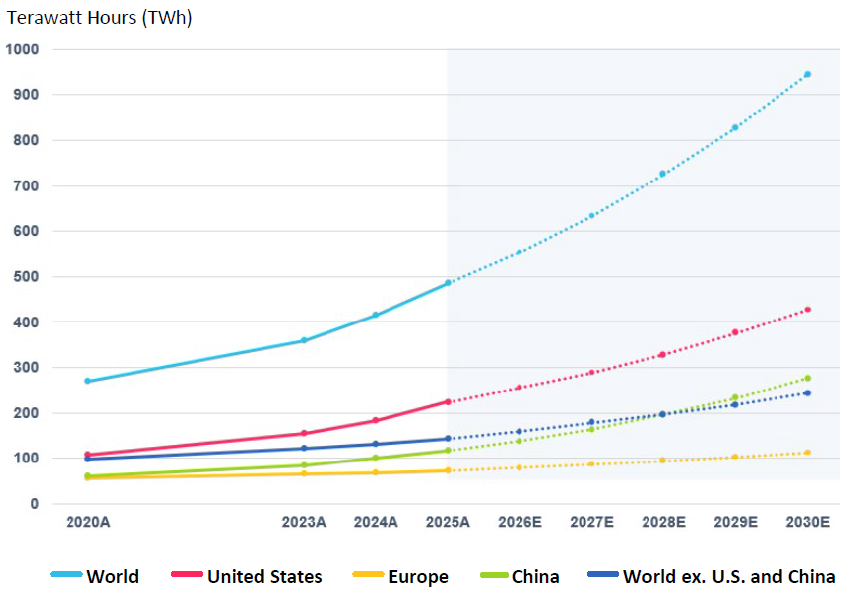
Source: IEA Energy & AI, 2022-2025.6
Lawrence Berkeley National Laboratory counted more than 2,060 gigawatts (GW) of proposed generation and storage seeking connection to the U.S. grid at the end of 2025.7 Most projects entering these generation queues are ultimately withdrawn, so queue volumes represent proposed capacity.
Lawrence Berkeley Lab's 2026 Speed to Power report identifies more than 40 potential approaches to accelerate large-load connections, ranging from forecasting, interconnection, procurement, grid operations and cost allocation.8 FERC has also directed all six regional grid operators under its jurisdiction to justify or reform their large-load connection rules.9 Some alternative transmission technologies can add capacity to existing lines in as little as one to three years, illustrating that the response may involve using existing infrastructure more productively as well as building new infrastructure.8
There is another side to the capacity equation: how efficiently the energy system uses what it already has. Lawrence Livermore National Laboratory's U.S. energy-flow analysis shows that a substantial share of primary energy does not ultimately become useful energy services, reflecting conversion losses and other forms of rejected energy across electricity generation, transportation and end use.10 There is also a question of asset utilization. Michael Webber of the University of Texas has described the U.S. power sector as a multitrillion-dollar asset base that historically has been utilized only about 45% of the time, in part because the system is built to accommodate periods of peak demand.11 As demand rises faster than some infrastructure can be expanded, reducing losses, shifting flexible loads and improving the productivity of existing energy assets may become increasingly valuable.
“There is another side to the capacity equation: how efficiently the energy system uses what it already has.”
The forecast keeps moving
More notable than any single demand forecast is how quickly the forecasts themselves have changed. In only three annual planning cycles, NERC's projected 10-year increase in North American summer peak demand rose from approximately 55 GW in its 2022 assessment to 80 GW in 2023, 132 GW in 2024 and 224 GW in 2025, more than quadrupling.12 The direction of future revisions remains uncertain, reinforcing the difficulty of relying on any single long-term forecast.
The challenge is that demand expectations can change much faster than the physical energy system. New generation, transmission and interconnection infrastructure can take years to plan, permit and build. The Lawrence Berkeley Lab found that the median project built in 2025 took approximately five years from its interconnection request to commercial operation, compared with three years in 2015 and less than two years in 2008.7 NERC currently identifies substantially more projected demand growth than approved new resources, while a much larger pipeline of prospective capacity remains subject to development and connection.12
Data centers are making that mismatch even more pronounced. The Electric Reliability Council of Texas (ERCOT) offers a glimpse of the scale (see Chart 2), where in Texas alone, data centers could account for roughly 25 GW of large-load demand by 2035.12 FERC estimates that the average data center entering service grew from roughly 25 MW in 2020 to almost 80 MW in 2025, with even larger facilities now under development.5 The Energy Information Administration (EIA), meanwhile, estimates that U.S. electricity demand grew approximately 1.7% annually from 2020 to 2025, compared with just 0.1% annually from 2005 to 2019 and identifies data-center electricity use as a driver of the recent increase.2
CHART 2: LARGE-LOAD PROJECTION BREAKDOWN IN ERCOT
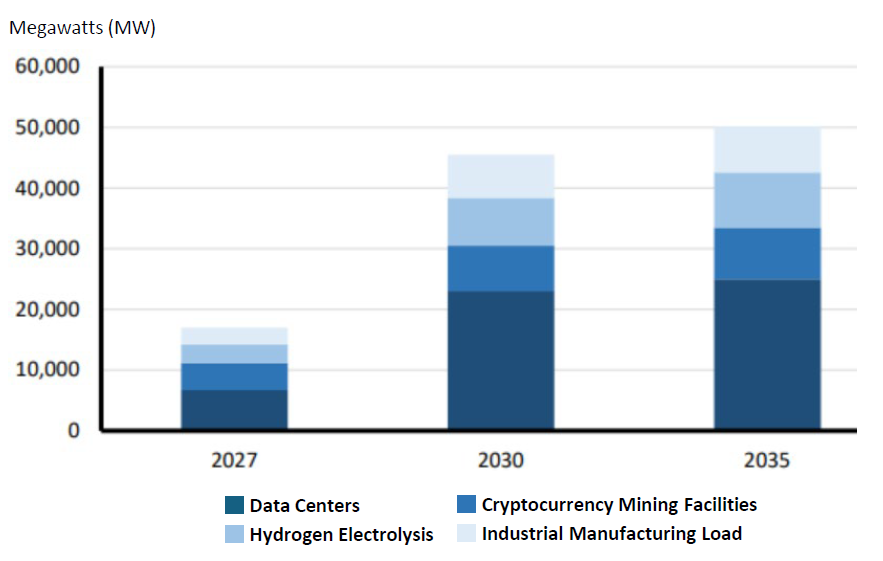
Source: NERC Long-Term Reliability Assessments, 2022-202512
Energy security still matters
While AI has changed the electricity-demand discussion, it has not displaced a more fundamental question: how does a country build an energy system that is affordable, diversified and secure? The history of energy shocks suggests further shocks will come, but the source and timing of the next disruption are inherently difficult to predict. For countries with relatively poor energy security, an energy disruption can quickly metastasize into an energy crisis. Russia’s invasion of Ukraine exposed Europe’s dependence on Russian gas and produced what the World Bank described as the largest commodity shock since the 1970s; the increase in energy prices was the largest since the 1973 oil crisis.13
Four years later, conflict involving Iran effectively closed the Strait of Hormuz, a route through which roughly 20 million barrels of crude oil and petroleum products had moved each day, equivalent to around 20% of global oil consumption. Brent crude futures began 2026 near $61 per barrel and ended the first quarter at $118, the largest inflation-adjusted quarterly increase in EIA data since 1988.14
CHART 3: ENERGY SHOCKS ARE BECOMING MORE FREQUENT
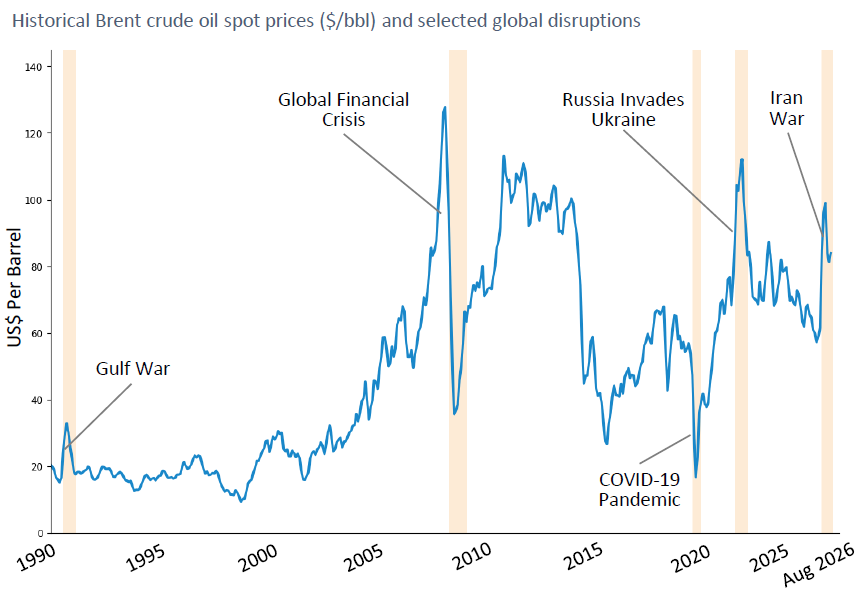
Source: U.S. Energy Information Administration (EIA), Brown Advisory analysis.
It is no surprise, then, to see energy security return to prominence. Energy resilience depends on having alternative sources when supply shocks materialize, robust infrastructure capable of absorbing that variety of supply, sufficient spare capacity and storage to maintain economic activity at an acceptable cost and, where economically viable, greater domestic production of molecules and electrons.
Efficiency belongs in the same discussion. An economy that can reduce energy demand through efficiency improvements is often better positioned to absorb supply disruptions and price shocks. Efficiency measures such as better building insulation, more efficient heating and cooling systems and distributed energy technologies can be deployed alongside public policy incentives to reduce pressure on the energy system during periods of scarcity. The IMF estimates that without improvements in energy efficiency, the lasting effect of the 2022 energy shock on euro-area GDP would have been roughly two-thirds larger. It is a notable silver lining for a continent that has repeatedly confronted the economic consequences of energy disruption this decade.16
For investors, this makes the precise path of energy prices, AI electricity demand or the future energy mix less important than understanding where a system is constrained, how individual businesses can respond when conditions change and where efficiency, reliability and resource productivity can create value across different outcomes.
Yet building greater energy resilience introduces another constraint: infrastructure has to be built somewhere. The rapid expansion of AI is making that tension increasingly visible. Much of the country also experienced one of its warmest years on record in 2026 (see Chart 4), adding to existing pressure on power and water systems just as new infrastructure demand accelerated.17 Data Center Watch identified $64 billion of U.S. data center projects blocked or delayed amid local opposition between May 2024 and March 2025. In the first half of 2026, its quarterly tracking identified roughly $198 billion of projects facing delays or blocks: $130 billion in the first quarter and another $68 billion in the second.18 Concerns vary by community but include electricity and water demand, infrastructure costs, noise and land use. The tension is increasingly clear: countries and companies want more abundant and resilient energy infrastructure, but building the physical infrastructure required to deliver it can itself become a constraint.
CHART 4: U.S. TEMPERATURE RANKINGS, 1895-2026
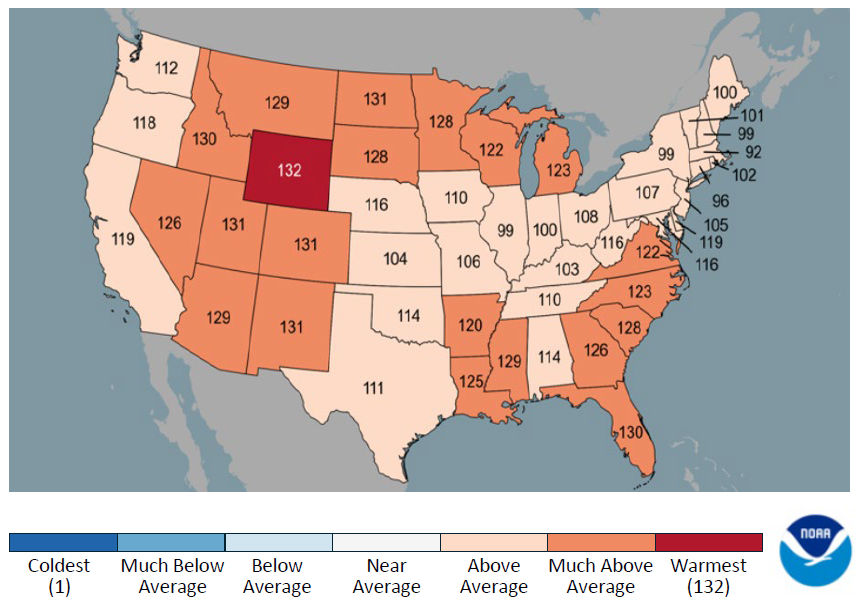
Source: National Oceanic and Atmospheric Administration (NOAA), as of 08/06/202617
CHART 5: BUILD AN ELECTRO-INDUSTRIAL BASE
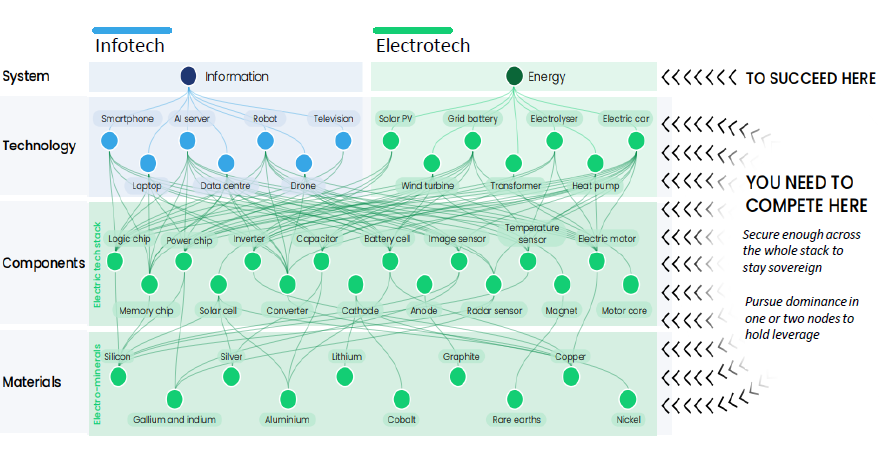
Source: Ember, The Age of Power, September 2026.19
The investment opportunity also extends well beyond generation itself. Modern energy and information systems depend on an increasingly interconnected stack of technologies, components and materials, creating potential opportunities (and constraints) across the industrial base. In our view, the framework above developed by Ember illustrates this interconnected system particularly well.
A bottom-up lens on energy expansion
The scale of the energy build-out can make it tempting to treat the opportunity as a single investment theme. We believe the more useful questions sit one level beneath the surface: Who can secure reliable power, where, at what cost and how quickly? Which businesses can use energy and infrastructure more efficiently? Where could water, grid capacity, or other physical constraints limit growth? And who ultimately pays for the infrastructure required to meet new demand?
Client conversations have sharpened these questions and helped us understand how the debate is evolving. Sustainable investment research is one input into a broader fundamental process, helping investment teams assess potentially material factors—including climate conditions, natural-resource availability, resilience, emissions, regulation and governance—alongside competitive position, management, capital allocation and valuation. Rather than assigning companies a single energy label, we focus on how these pressures affect individual businesses and their long-term economics.
Where the constraints show up
Higher demand creates a clear need for additional supply. But when energy, grid capacity, water and infrastructure are constrained, producing and using resources more productively can create value in its own right. The following holdings show how Brown Advisory investment teams encounter these pressures differently across strategies.
Weatherford International plc (WFRD), held in the Brown Advisory Large-Cap Sustainable Value Strategy, is an oilfield services and technology company that provides equipment, software and services used to drill, complete and operate oil and gas wells.20 One increasingly important part of that offering is helping operators get more from wells they have already drilled. Weatherford’s ForeSite platform continuously collects operating data from producing wells, allowing equipment to be adjusted remotely and emerging problems to be identified before they interrupt production—reducing the labour required in the field, extending equipment life and helping wells produce more consistently.21 In the Permian Basin, an operator initially deployed the technology across more than 80 wells before expanding it toward roughly 1,000, with at least $17 million of expected annualized savings from personnel efficiency, longer equipment run-life and improved production.21 In an energy system where new supply can take time to develop, technologies that improve the productivity and resource efficiency of existing production offer another way to respond to rising demand.
CHART 6: COMPANY EXAMPLES ACROSS THE ELECTRICITY SYSTEM
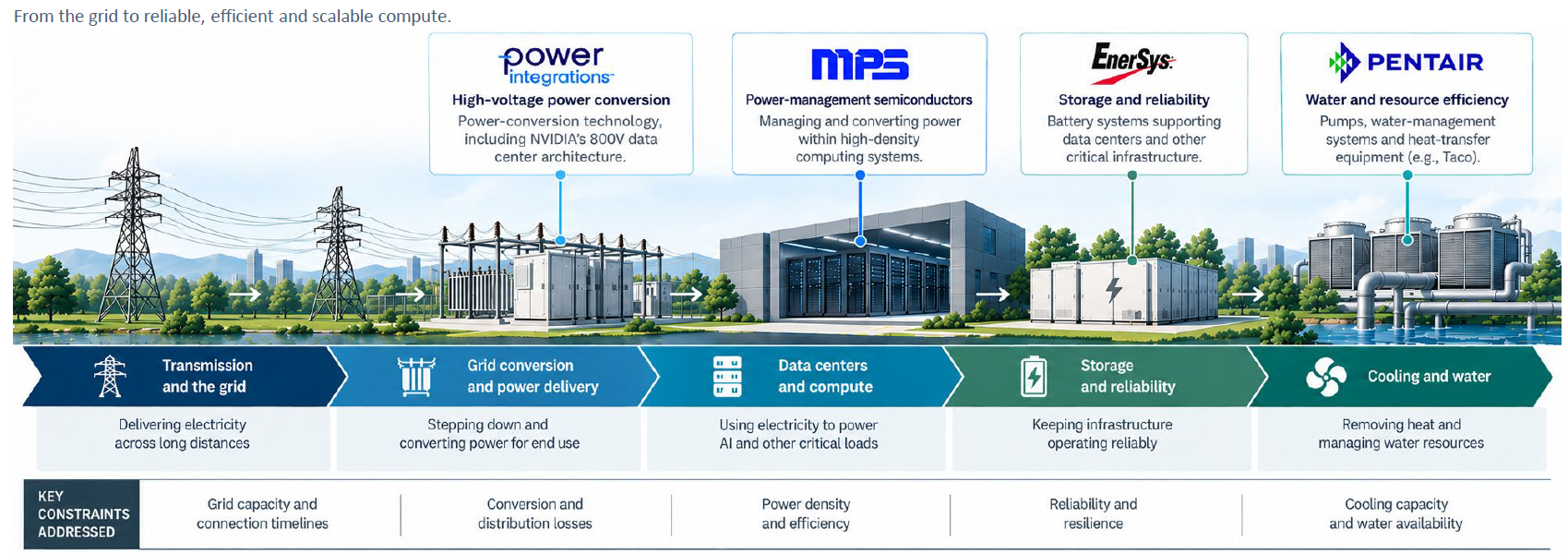
Source: Brown Advisory
Monolithic Power Systems Inc. (MPWR), held in the Brown Advisory Large-Cap Sustainable Growth Strategy, develops the semiconductors that manage how electricity is converted and delivered inside computing systems.22 As AI has packed more computing power into each data-center rack, the amount of electricity that must travel through the same confined space has risen sharply with it. Three years ago, MPWR targeted a system capable of supplying 120kW to a single rack by 2027; it reached that target in 2024 and is now developing systems for racks exceeding 500kW, meaning more than four times as much power must be delivered through roughly the same physical footprint.23 At these densities, electricity lost before reaching the processors becomes heat instead of computation, adding to both the power bill and the cooling burden. MPWR says its “Z-Axis” architecture can reduce these distribution losses fivefold, while its smaller power components leave more room for GPUs.24 This rising rack density makes power management a more valuable part of the system. Reducing losses and physical footprint allows customers to extract more computing output from the power, cooling and infrastructure they have already paid for.
Power Integrations Inc (POWI), held in Brown Advisory’s Sustainable Small-Cap Core Strategy, develops semiconductor technologies used to convert high-voltage electricity efficiently in applications ranging from industrial equipment and appliances to renewable-energy systems and data centers.25 In other words, the technology helps electricity reach the equipment that needs it with less energy lost along the way. This is increasingly relevant in AI data centers, where large amounts of electricity must be delivered to increasingly powerful computing equipment within a limited physical footprint. In June, Power Integrations introduced designs for NVIDIA’s new 800 VDC AI data-center architecture that it says can achieve 88% power-conversion efficiency while reducing the space needed for power components by approximately 30%.26 In practical terms, this means more of the electricity entering the system reaches the computing equipment, while the equipment needed to manage that power takes up less space. As rack power densities rise, reducing conversion losses and the physical footprint of power components becomes increasingly valuable to an AI infrastructure player. In our view, Power Integrations’ ability to address both constraints in a single design strengthens its competitive proposition as AI data centers move toward higher-voltage power architectures, illustrating how resource constraints can increase the economic value of efficiency. Reliability is broader than electricity generation. A resilient energy system also depends on the physical services and infrastructure that allow critical assets to operate safely and consistently.
As more computing power is packed into the same physical footprint, every part of the data center has to work harder. The previous example showed how smaller, more efficient power-conversion equipment can free space for computing; EnerSys (ENS), held in the Brown Advisory Sustainable Small-Cap Core Strategy, addresses another part of the same equation – storing enough power to keep increasingly dense infrastructure running reliably.27
EnerSys has spent more than a century in stored energy and today serves more than 10,000 customers across 100 countries, including data centers, communications networks and other critical infrastructure.28 As AI increases the amount of power concentrated within data centers, that experience is being applied to a new generation of storage systems designed to deliver substantially more power and energy from a compact footprint. EnerSys sold over 11 GWh of battery storage capacity in FY2026, illustrating the scale of the platform from which it can pursue this opportunity.29 For our investment team, EnerSys is an example of an established business whose expertise becomes increasingly valuable as infrastructure is asked to support more computing, more electricity and greater demands for reliability within the same physical constraints.
CHART 7: DATA CENTER ELECTRICITY WATER DEPENDENCY AND HISTORICAL DROUGHT EXPOSURE BY STATE
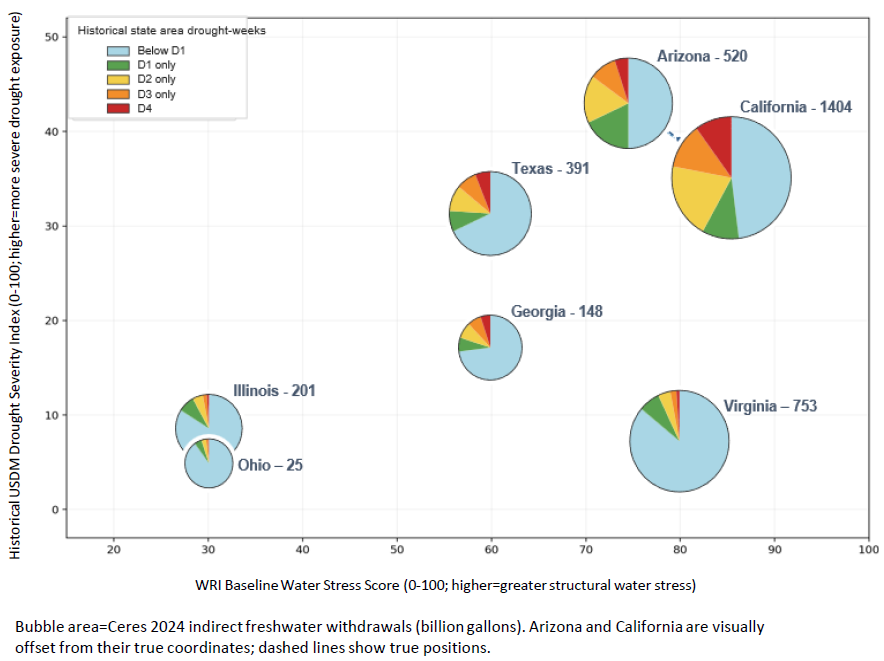
Source: Ceres, USDM 2011-202429
Electricity is only one part of the physical infrastructure needed to support AI. The enormous concentration of computing inside modern data centers also produces heat that must be removed continuously, bringing cooling and water into the same capacity equation. A 2026 Ceres analysis of seven states representing roughly half of U.S. data centers estimates that the electricity supplying them depends on approximately 3.4 trillion gallons of freshwater withdrawals annually, around 12 times the annual water use of Los Angeles, Phoenix and Washington, D.C. combined.30 As compute becomes more power intensive, the ability to move water, manage heat and provide cooling will directly influence how much infrastructure can be supported in a given location.
Pentair PLC (PNR), held in the Brown Advisory Large-Cap Sustainable Value Strategy, has spent decades building expertise around precisely these physical processes, developing pumps, controls and water-management technologies used across buildings and industrial systems.31 In July 2026, Pentair agreed to acquire Taco Group for approximately $1.4 billion, extending that expertise into the systems used to circulate water and transfer heat, with data centers identified by Pentair as an additional high-growth opportunity.32 Rising compute density could make those capabilities increasingly valuable as cooling becomes another constraint on data-center growth, while Taco's broad customer base and large installed base provide demand for replacement and upgrades well beyond AI infrastructure. For our investment team, Pentair illustrates why we focus less on predicting the precise path of energy demand and more on the constraints that emerge around it. Faster data-center growth could increase the value of its water and cooling expertise, while those same capabilities remain relevant across a much broader need to use water and physical infrastructure more productively.
Investing across a diversified energy system
The energy-expansion thesis has evolved, but its direction is unchanged. Electricity demand is rising, while grid constraints are becoming more visible in large-load interconnection and generation-queue data. Security, affordability and reliability remain central and climate conditions, water availability and other resource pressures can materially affect the economics of individual businesses and projects.
The holdings above are not intended to represent a thematic basket. They illustrate how different investment teams can encounter the same broad pressures through company-specific research: Weatherford through energy productivity, Monolithic Power Systems and Power Integrations through power efficiency, EnerSys through energy storage and reliability and Pentair through water and resource efficiency.
We do not need to predict exactly how much electricity AI will consume, which generation technology will grow fastest, what the next geopolitical shock will be, or how the global energy mix will evolve by 2050.
For bottom-up investors, pressure points across the energy system can provide useful information about company economics and the ability of businesses to respond as conditions change. These pressures can reveal opportunities in productivity, efficiency, reliability and resource management that may be overlooked when energy is viewed through a single sector, technology, or label.
Energy expansion is not one investment theme. It reflects a set of economic pressures moving through the real economy. Understanding those pressures and evaluating them company by company, is where we believe bottom-up research can add value.
1. Brown Advisory, Energy Expansion and Independence, Part 1: The Forces Shaping Global Energy, 2025. https://www.brownadvisory.com/sites/default/files/2025-07/Energy-Article-Part1.pdf
2. U.S. Energy Information Administration (EIA), “Fossil generation could rise with faster-than-expected growth in data center power demand,” March 12, 2026. https://www.eia.gov/todayinenergy/detail.php?id=67344
3. U.S. Energy Information Administration, “Crude oil and petroleum product prices increased sharply in the first quarter of 2026,” April 7, 2026. https://www.eia.gov/todayinenergy/detail.php/detail.php?id=67424
4. Brown Advisory, Energy Resilience Meets AI: Corporate Opportunities, September 2026. https://www.brownadvisory.com/us/insights/energy-resilience-meets-ai-corporate-opportunities
5. Federal Energy Regulatory Commission (FERC), State of the Markets 2025, March 2026. https://www.ferc.gov/sites/default/files/2026-03/26_State-of-the-Market_0324_1430.pdf
6. International Energy Agency (IEA), Key Questions on Energy and AI, 2026. https://www.iea.org/reports/key-questions-on-energy-and-ai/executive-summary
7. Lawrence Berkeley National Laboratory, Queued Up: 2026 Edition, July 2026. https://emp.lbl.gov/queued-2026-edition-characteristics-power-plants-seeking-transmission-interconnection-end-2025
8. Lawrence Berkeley National Laboratory, Speed to Power: Solutions for Accelerating Large Load Connections, June 2026. https://emp.lbl.gov/publications/speed-power-solutions-accelerating
9. Federal Energy Regulatory Commission, “FERC Launches Aggressive Targeted Action to Speed Large Load Integration,” June 18, 2026. https://www.ferc.gov/news-events/news/ferc-launches-aggressive-targeted-action-speed-large-load-integration
10. Lawrence Livermore National Laboratory, U.S. energy flow charts. https://flowcharts.llnl.gov/
11. Michael E. Webber, Power Trip: The Story of Energy, Yale University Press, 2019.
12. North American Electric Reliability Corporation (NERC), 2025 Long-Term Reliability Assessment infographic and industry webinar. NERC reports 10-year summer peak-demand growth of 55 GW in the 2022 assessment, 80 GW in 2023, 132 GW in 2024 and 224 GW in 2025, and identifies 71 GW of approved summer resource additions. https://www.nerc.com/globalassets/our-work/assessments/ltra_infographic_2025.pdf and https://www.nerc.com/globalassets/programs/rapa/ra/2025_ltra_industry_webinar.pdf
13. World Bank, “Food and Energy Price Shocks from Ukraine War Could Last for Years,” April 26, 2022. https://www.worldbank.org/en/news/press-release/2022/04/26/food-and-energy-price-shocks-from-ukraine-war
14. U.S. Energy Information Administration, “Crude oil and petroleum product prices increased sharply in the first quarter of 2026,” April 7, 2026. https://www.eia.gov/todayinenergy/detail.php?id=67424
15. Source: U.S. Energy Information Administration (EIA), Brown Advisory analysis. U.S. Energy Information Administration (EIA), “Europe Brent Spot Price FOB (Dollars per Barrel)” https://www.eia.gov/dnav/pet/hist/LeafHandler.ashx?n=PET&s=RBRTE&f=M
16. International Monetary Fund, “Toward a European Energy Union,” June 11, 2026. https://www.imf.org/en/news/articles/2026/06/11/sp061126-md-toward-a-european-energy-union
17. National Oceanic and Atmospheric Administration (NOAA), National Centers for Environmental Information, as of 08/06/2026.
18. Data Center Watch, “Q2 2026 Data Center Development Report,” 2026. https://www.datacenterwatch.org/q2-2026
19. Source: Ember, The Age of Power, September 2026. Used under CC BY 4.0.
20. Source: FactSet®, as of 08/31/2026. The company is held in the Brown Advisory Large-Cap Sustainable Value Strategy. The portfolio information is based on a representative Large-Cap Sustainable Value account.
21. Weatherford International, ForeSite production-optimization case study, Permian Basin. https://www.weatherford.com/energy-solutions/integrated-services/integrated-intervention-and-production-solutions/
22. Source: FactSet®, as of 08/31/2026. The company is held in the Brown Advisory Large-Cap Sustainable Growth Strategy. The portfolio information is based on a representative Large-Cap Sustainable Growth account.
23. Monolithic Power Systems, 2026 Corporate Responsibility Report. https://www.monolithicpower.com/media/mps_cms_document/c/o/corporate-responsibility-report-2026.pdf
24. Monolithic Power Systems, 2026 Corporate Responsibility Report. https://www.monolithicpower.com/media/mps_cms_document/2/0/2026_corporate-responsibility-report.pdf
25. Source: FactSet®, as of 08/31/2026. The company is held in the Brown Advisory Sustainable Small-Cap Core Strategy. The portfolio information is based on a representative Sustainable Small-Cap Core account.
26. Power Integrations, “Power Integrations Unveils Space-Saving, Ultra-Slim Auxiliary PSU Reference Designs for NVIDIA Kyber 800 VDC AI Data Center,” June 1, 2026. https://investors.power.com/news/news-details/2026/Power-Integrations-Unveils-Space-Saving-Ultra-Slim-Auxiliary-PSU-Reference-Designs-for-NVIDIA-Kyber-800-VDC-AI-Data-Center/default.aspx
27. Source: FactSet®, as of 08/31/2026. The company is held in the Brown Advisory Sustainable Small-Cap Core Strategy. The portfolio information is based on a representative Sustainable Small-Cap Core account.
28. EnerSys, 2026 Sustainability Report, 2026. https://www.enersys.com/4a7f84/globalassets/documents/corporate/sustainability/policies_and_reports/enersys_sustainability-report-2026_092526_final.pdf
29. EnerSys, 2026 Sustainability Report, 2026, p. 44. https://www.enersys.com/4a7f84/globalassets/documents/corporate/sustainability/policies_and_reports/enersys_sustainability-report-2026_092526_final.pdf
30. Ceres, Water Behind the Watts: The Hidden Risk of Powering Data Centers, 2026. https://www.ceres.org/resources/reports/water-behind-the-watts-the-hidden-risk-of-powering-data-centers
31. Source: FactSet®, as of 08/31/2026. The company is held in the Brown Advisory Large-Cap Sustainable Value Strategy. The portfolio information is based on a representative Large-Cap Sustainable Value account.
32. Pentair, “Pentair to Acquire Taco Group Holdings, Accelerating Growth and Creating a Comprehensive Suite of Innovative Water Solutions,” July 28, 2026. https://investors.pentair.com/news-releases/news-release-details/pentair-acquire-taco-group-holdings-accelerating-growth-and
Disclosures
All investments involve risk, including possible loss of principal. Please see each product's web page for specific details regarding investment objective, risks, performance, and other important information. Review this information carefully before you make any investment decision.
The views expressed are those of the author and Brown Advisory as of the date referenced and are subject to change at any time based on market or other conditions. These views are not intended to be and should not be relied upon as investment advice and are not intended to be a forecast of future events or a guarantee of future results.
The information provided in this material is not intended to be and should not be considered to be a recommendation or suggestion to engage in or refrain from a particular course of action or to make or hold a particular investment or pursue a particular investment strategy, including whether or not to buy, sell or hold any of the securities or funds mentioned. It should not be assumed that investments in such securities have been or will be profitable. To the extent that specific securities are mentioned, they have been selected by the author on an objective basis to illustrate views expressed in the commentary and do not represent all of the securities purchased, sold or recommended for advisory clients. This material is intended solely for our clients and prospective clients, is for informational purposes only and is not individually tailored for or directed to any particular client or prospective client.
The information contained herein has been prepared from sources believed reliable but is not guaranteed by us as to its timeliness or accuracy and is not a complete summary or statement of all available data. The information in this document has not been independently reviewed or audited by outside certified public accountants. The information provided is not intended to be a forecast of future events or a guarantee of future results.
Sustainable investment considerations are one of multiple informational inputs into the investment process, alongside data on traditional financial factors, and so are not the sole driver of decision-making. Sustainable investment analysis may not be performed for every holding in every strategy. Sustainable investment considerations that are material will vary by investment style, sector/industry, market trends and client objectives. Certain strategies seek to identify companies that we believe may be desirable based on our analysis of sustainable investment related risks and opportunities, but investors may differ in their views. As a result, these strategies may invest in companies that do not reflect the beliefs and values of any particular investor. These strategies may also invest in companies that would otherwise be excluded from other funds that focus on sustainable investment risks. Security selection will be impacted by the combined focus on sustainable investment research assessments and fundamental research assessments including the return forecasts. These strategies incorporate data from third parties in its research process but do not make investment decisions based on third-party data alone.
Brown Advisory uses artificial intelligence (“AI”) tools to assist with analyzing and summarizing various data and information. All AI assisted outputs are reviewed and validated by the Brown Advisory Investment team, and these tools do not replace or inform the firm’s independent fundamental research or investment decision making. AI is not involved in the management of any Brown Advisory fund or strategy.