
In late August, my wife and I officially became empty nesters as we dropped our youngest off at college. It was bittersweet for us as it is for most parents during this major life transition. The household suddenly carries less complexity and chaotic energy. Dinner discussions shift from the kids’ daily schedules and related logistics to our own pursuits. I can finally find my shoes in the refreshingly uncluttered hall closet. Perhaps the most palpable (and rewarding) change is that for the first time in decades, our discretionary spending can prioritize our own interests. Most recently, we found ourselves debating the merits of an updated outdoor patio versus visiting the French capital.
Our conversation reflects a trade-off that millions of households increasingly face: Should the next dollar be spent creating memories or improving the place we call home? For many decades, American consumers have responded with their wallets – an increasing amount of their discretionary spending has shifted toward travel, restaurants, concerts, sporting events, cruises, and outdoor recreation. Meanwhile, categories associated with “nesting” – home furnishings, remodeling, and other household investments – have surrendered wallet share.
CHART 1: EXPERIENCES VS. NESTING AS % OF TOTAL U.S. PERSONAL CONSUMPTION EXPENDITURES (PCE), 1980-2025 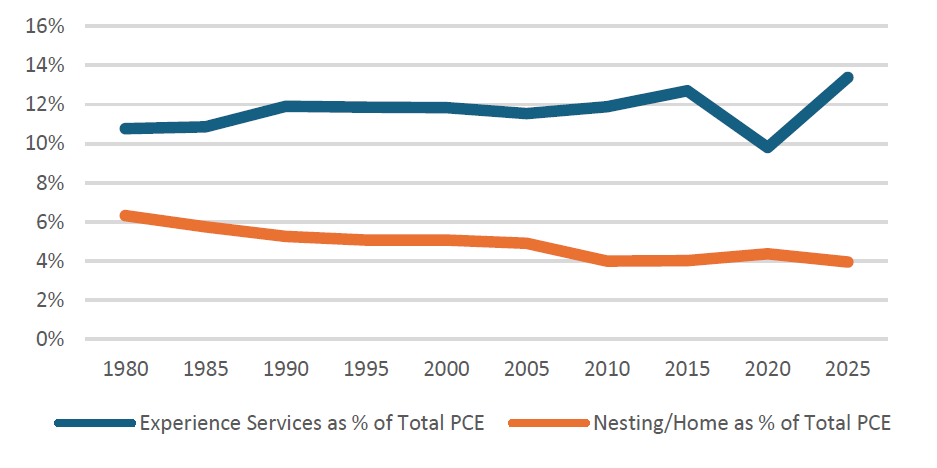
Note: “Experiences” includes recreation services, food services and accommodations, air transportation, water transportation, and foreign travel by U.S. residents. “Nesting” includes furnishings and durable household equipment, household maintenance, and household supplies.
Source: Bureau of Economic Analysis as of 09/09/2026.
While the concept of “revenge travel” peaked earlier this decade following the pandemic, it further revealed a deep secular reallocation of discretionary spending toward experiences. In their seminal 2003 paper, To Do or to Have? social psychologists Thomas Gilovich and Leaf Von Boven found that experiential purchases tend to generate more lasting happiness than material ones. Simply asking people to reflect on an experience generates more positive emotion than asking them to reflect on their most prized possessions.
Why? Experiences become woven into our identity. They create stories that we tell and retell. Showing your friends your redecorated living and dining rooms might occupy their attention for a few minutes. A Labor Day weekend in New York – witnessing Carlos Alcaraz dazzle at the U.S. Open before becoming entranced by the sounds of Buena Vista Social Club on Broadway – is the kind of experience that can find an enduring home in your soul, growing richer in memory long after the luster of home décor has faded.
For many decades, Americans have traveled near and far to accumulate these prized memories. In 1989, only about 3% of U.S. citizens held a passport.1 Today, more than half do. That single statistic captures how dramatically Americans’ horizons have expanded. As Americans became wealthier and more connected to the rest of the world, activities once reserved for the fortunate few became attainable for millions.
CHART 2: VALID U.S. PASSPORTS, 1989-2025 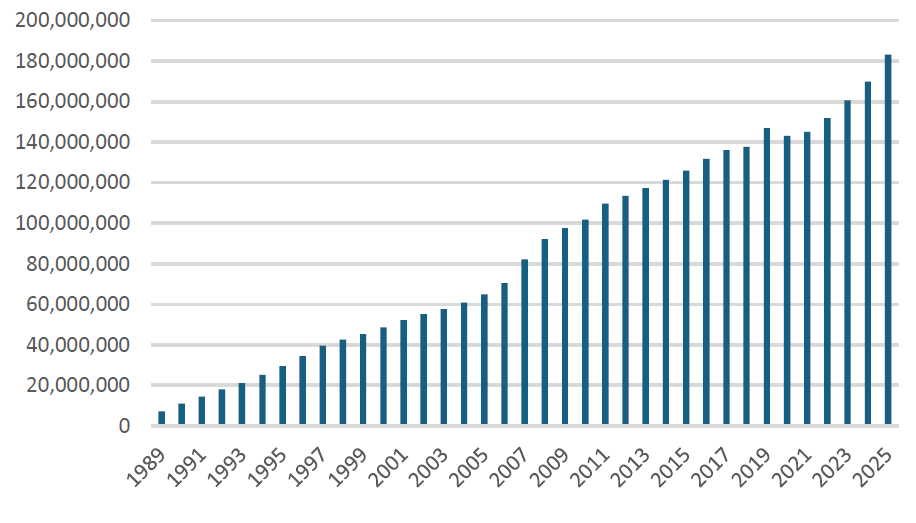
Source: U.S. State Department as of 09/09/2026.
Investment Implications
The obvious investment conclusion would be to own companies that sell experiences and avoid those selling possessions. However, there is significantly more nuance to that for equity investors in the consumer discretionary sector. First, there is a marked difference in performance between companies selling more aspirational experiences than functional or utilitarian ones. Next, there is an emerging category of companies we’ll distinguish as “experience enablers” that sell possessions but trade like experiential companies. Lastly, there is likely a point in time in which possession-related stocks can outperform, although these have been value traps of late.
Destination Versus Accommodation
Hilton and Marriott are globally trusted brands that aim to elevate the travel experience. Their portfolios are concentrated in upper midscale through luxury lodging. Both brands have extensive customer loyalty programs of well over 200 million members. In contrast, Choice Hotels and Wyndham have portfolios that are oriented toward travelers prioritizing convenience, consistency and value. Hilton and Marriott have enjoyed stronger underlying demand in recent years as affluent consumers have remained remarkably resilient, demonstrated both by better revenue per available room (“RevPAR”) growth, as well as stock price performance.
CHART 3: PREMIUM VS. VALUE HOTELS STOCK PERFORMANCE SINCE END 2021 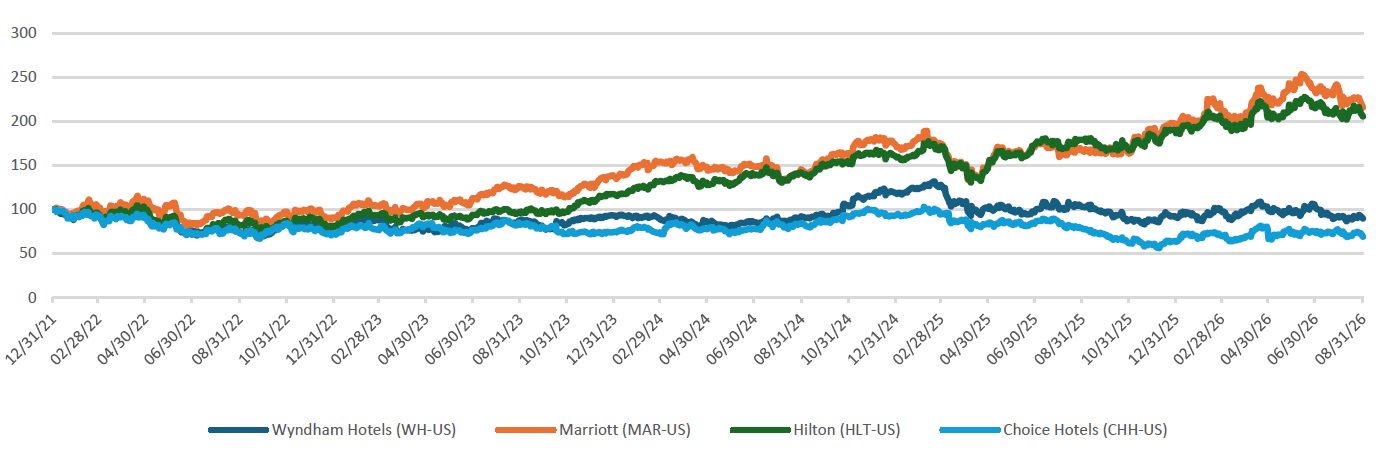
Note: Performance indexed to 100 on 12/31/2021.
Source: FactSet as of 09/09/2026.
Experience Enablers
A handful of companies sell tangible objects whose primary purpose is enabling memorable experiences. I would classify them as experience enablers. They have also generated some of the strongest shareholder returns among consumer discretionary companies in recent years. Apple is a notable example. Few products have changed how people experience the world as profoundly as the iPhone. Is it a possession? Yes, but it has become the operating system for modern experiences. It guides us through unfamiliar cities, boards our flights, and preserves memories long after the trip has ended.
Garmin is another. The company’s mission is to create products designed for people who live an active lifestyle. When someone purchases a Garmin Forerunner or Fenix, they are committing themselves to becoming a runner, or hiking the Appalachian Trail, or competing in their club golf championship. The Garmin wristwatch is a gateway to healthier lives, outdoor adventures, and personal achievement.
Few possessions generate more memories than a Ferrari. Technically it is a car, but its owners are not simply purchasing transportation. They’re buying mountain roads, track days, and membership to one of the world’s most passionate enthusiast communities. The car is merely the conduit for the experience. When we consider commonalities across Apple, Garmin and Ferrari, all three derive their value from the memories, identity and experiences that accumulate around their customers.
CHART 4: EXPERIENCE ENABLERS STOCK PERFORMANCE SINCE END 2021 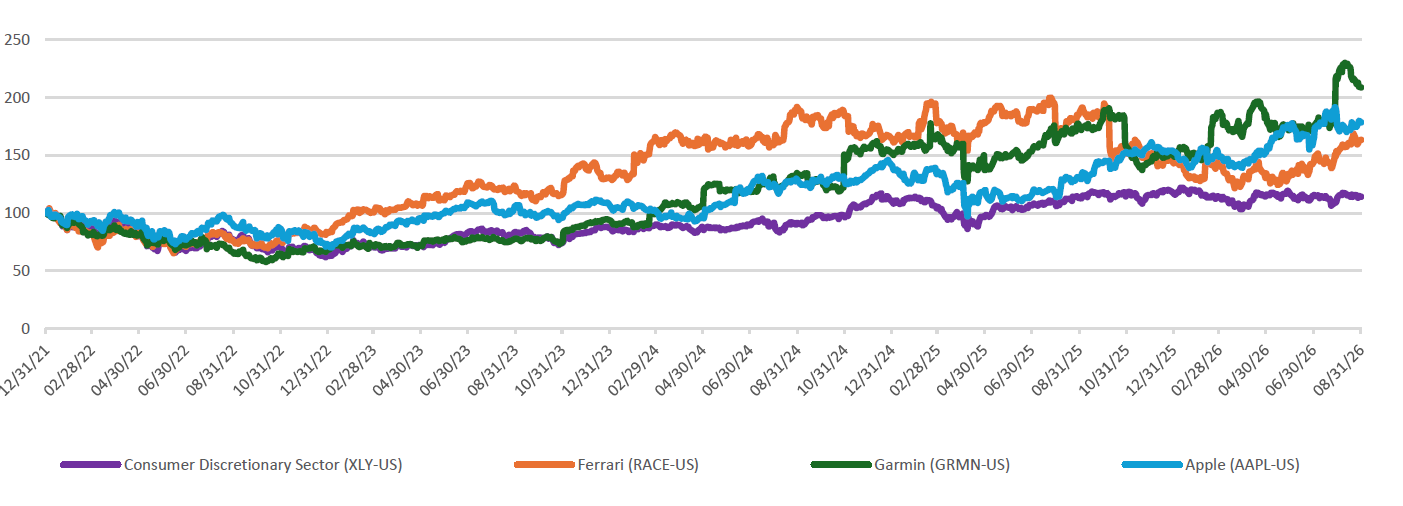
Note: Performance indexed to 100 on 12/31/2021.
Source: FactSet as of 09/09/2026.
When Will Functional Possession Stocks Have Their Day?
None of the winners described thus far are undiscovered investments today. At the same time, there is no shortage of companies selling appliances, furniture, flooring, and home furnishings that have produced subpar shareholder returns in recent years. What could transform these stocks that look like value traps today into market leaders tomorrow?
CHART 5: ANNUALIZED RETURN, END 2021 THROUGH AUG 2026 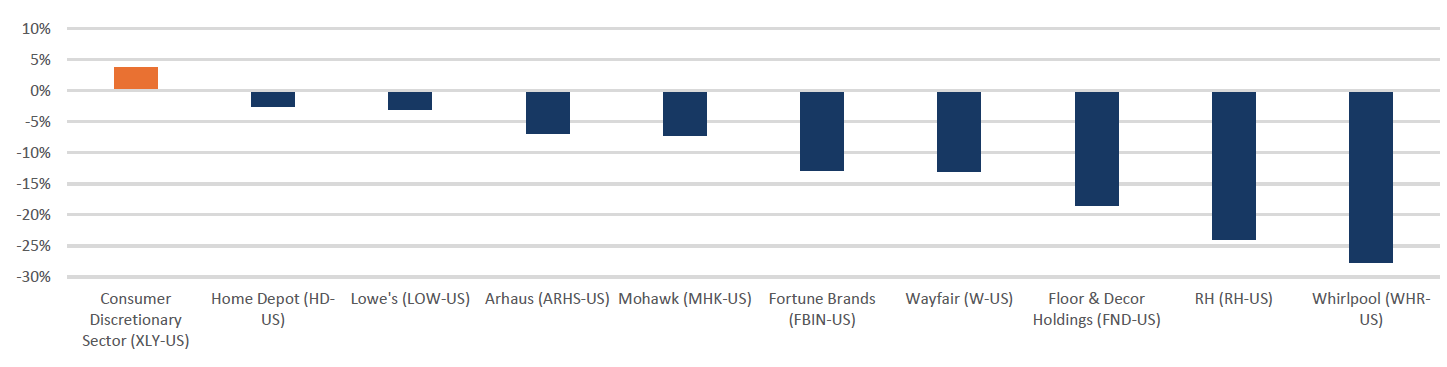
Source: FactSet as of 09/09/2026.
Most functional possession companies are attached at the hip to housing turnover. When an existing home changes hands, it sets off a chain reaction of spending, often referred to as the housing multiplier. To attract buyers, a seller will often refresh the home before listing by applying a fresh coat of paint, and replace worn carpet or flooring, as well as appliances. A new homeowner may invest in furniture to personalize the home, as well as outdoor living equipment.
However, existing home sales have been running at only 4.0-4.1 million units annually, roughly 20-25% below the long-term average, and nearly 40% below the 2021 peak. In fact, the U.S. has nearly 80 million more people than it did in 1995, yet existing home sales recently fell to their lowest level since then.2 The large gap between prevailing mortgage rates and those already held by homeowners, resilient home prices, and delayed household formation are all responsible for the cyclical trough in housing turnover.
If home transactions were to gradually normalize over time through a decline in mortgage rates, life changes, and rising incomes, possession-related stocks would likely have their day. The leading indicators worth considering in advance of the cycle turning would be a meaningful increase in new listings, pending home sales and mortgage applications for new home purchases.
CHART 6: U.S. EXISTING HOME SALES, PAST 30 YEARS
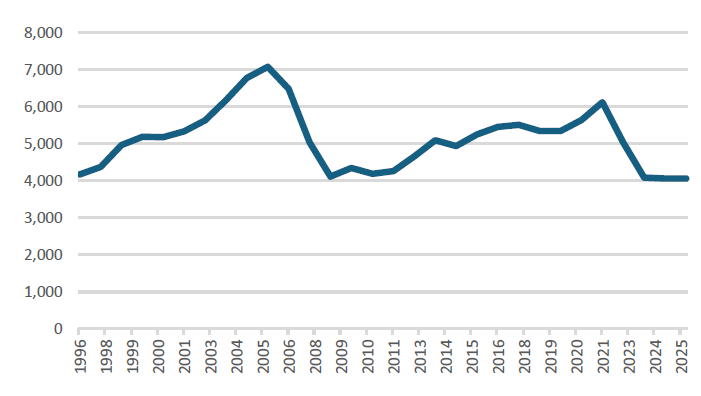
Source: National Association of Realtors via Federal Reserve Economic Data as of 09/09/2026.
The other potential catalyst for these stocks is more secular in nature, although it carries a long-time horizon. Over the next two decades, tens of trillions of dollars are expected to pass from Baby Boomers to younger generations. This summer, Visa Business and Economic Insights estimated approximately $36 trillion will ultimately reach heirs, with spending concentrated on housing, autos, travel, and retail.3 By easing the down-payment constraint for many younger households, the “Great Wealth Transfer” could pull forward the life stage where housing-related spending accelerates. However, this is likely to occur gradually and thus will require patience among investors who are drawn to this theme.
Markets have already recognized the winners of the experience economy. The harder, and potentially more profitable question is determining when the market begins to discount the eventual revival of housing turnover. Whether that inflection point arrives during 2027 or well into the future is impossible to know. But history suggests that by the time housing turnover has normalized, the investment opportunity will have passed.
Conclusion
The next time you face a discretionary purchase – whether it’s a patio renovation or a trip to Paris – you’ll be making the same decision millions of households make every day. For consumers like my wife and me, it is a very personal choice. For investors, it’s a reminder that the best consumer franchises are rarely defined by the products they sell, but by the aspirations they fulfill. Hotels, smartphones, watches, and even automobiles become conduits for exploration, achievement and memories that compound over a lifetime.
Eventually, many households will renovate the patio. Housing turnover will recover, remodeling activity will accelerate, and today’s neglected housing-related stocks will likely have their turn. But those businesses generally reward investors who correctly anticipate the cycle – a task that has historically carried a high degree of difficulty. By contrast, investors can often own companies that fulfill enduring human aspirations through an entire cycle.
Thanks for reading, and remember to never skip a Beat – Eric
1. Source: U.S. State Department as of 09/09/2026.
2. Source: Federal Reserve and U.S. Census Bureau as of 09/09/2026.
3. Source: Visa; Visa Business and Economic Insights as of 07/08/2026.
Disclosures
Stocks: Ferrari (RACE), Garmin (GRMN), Apple (AAPL), Home Depot (HD), Lowe’s (LOW), Arhaus (ARHS), Mohawk (MWK) Fortune Brands (FBIN), Wayfair (W), Floor & Decor Holdings (FND), RH (RH), Whirlpool (WHR), Wyndham Hotels (WH), Marriott (MAR), Hilton (HLT), and Choice Hotels (CHH).
Source: FactSet®. FactSet is a registered trademark of FactSet Research Systems, Inc.
Sectors are based on the Global Industry Classification Standard (GICS ®) classification system. Global Industry Classification Standard (GICS®) and “GICS” are service makers/trademarks of MSCI and Standard & Poor’s.
The views expressed are those of the author and Brown Advisory as of the date referenced and are subject to change at any time based on market or other conditions. These views are not intended to and should not be relied upon as investment advice and are not intended to be a forecast of future events or a guarantee of future results.
Past performance is not a guarantee of future performance and you may not get back the amount invested.
The information provided in this material is not intended to and should not be considered to be a recommendation or suggestion to engage in or refrain from a particular course of action or to make or hold any of the securities mentioned or pursue any particular investment strategy. It should not be assumed that investments in such securities have been or will be profitable. To the extent specific securities are mentioned, they have been selected by the author on an objective basis to illustrate views expressed in the commentary and do not represent all of the securities purchased, sold or recommended for advisory clients. The information contained herein has been prepared from sources believed to be reliable but is not guaranteed by us as to its timeliness or accuracy and is not a complete summary or statement of all available data. This piece is intended solely for our clients and prospective clients, is for informational purposes only, and is not individually tailored for or directed to any particular client or prospective client.
An investor cannot invest directly into an index.
The Consumer Discretionary Select Sector SPDR Fund (XLY) is an exchange-traded fund that tracks the performance of consumer discretionary companies in the S&P 500 Index.