
Fast Reading
- The 2025 tax legislation established a permanent statutory framework for the Opportunity Zone program under current law. For qualifying post-2026 investments, eligible gain generally may be deferred until an inclusion event or five years after investment, with a potential 10% reduction in deferred gain after five years and potential exclusion of qualifying appreciation after at least 10 years.1*
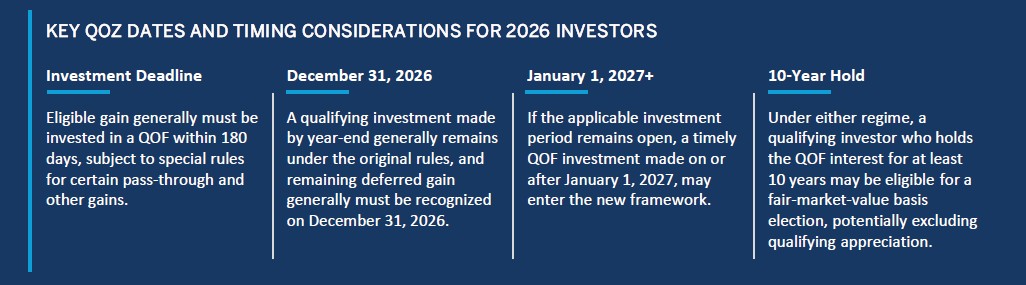
- Timing is especially important for investors recognizing gain in 2026. A Qualified Opportunity Fund (QOF) investment made by December 31, 2026, generally remains subject to the original rules, including year-end gain recognition. A timely investment made on or after January 1, 2027, may qualify for the new five-year framework.4
- Eligible gain generally must be invested in a QOF within 180 days, although partnership, pass-through and certain other gains can have special timing rules. Identify the investment deadline before selecting a fund.2
- Tax benefits should enhance a sound investment, not justify a weak one. Manager quality, underwriting, fees, leverage, liquidity and long-term portfolio fit remain decisive.
A business sale, real estate disposition or monetization of concentrated stock can create an immediate tax issue and a longer-horizon allocation decision. The gain is visible right away. The durable question is how the resulting capital should be invested for the next decade and beyond.
Qualified Opportunity Zones (QOZs) sit at the intersection of those decisions. By reinvesting eligible gain in a Qualified Opportunity Fund, an investor may obtain favorable federal tax treatment while directing capital to qualifying businesses or property in designated communities. The qualifying amount is generally the eligible gain, and the investment commonly must be made within 180 days, although special timing rules can apply.2
A QOF remains a private investment. It may involve development or operating risk, leverage, capital calls, limited liquidity, uncertain distributions and a holding period extending through several market cycles. The practical question is whether the investment fits the client’s objectives, balance sheet, risk tolerance and need for flexibility.
Why Opportunity Zones Deserve Another Look
When Opportunity Zones were created in 2017, the program had a finite feeling. The original rules were tied to a fixed December 31, 2026, gain-recognition date, and investors had to evaluate opportunities against the possibility that the incentive would not be renewed.
The 2025 legislation changed that backdrop. It removed the one-time sunset on new deferral elections, introduced recurring designation cycles and established a framework for investments made after 2026. Census tracts certified during 2026 will enter a designation period beginning January 1, 2027 and ending December 31, 2036, with later rounds expected on a decennial basis.
Treasury and the IRS expect to identify the new QOZs before January 1, 2027.1,3
For amounts invested in QOFs after December 31, 2026, deferred gain is generally included in income in the taxable year that includes the earliest of a sale or exchange, another inclusion event or the date five years after investment. A five-year hold generally produces a 10% basis increase in the deferred gain. A Qualified Rural Opportunity Fund may provide a 30% basis increase if statutory requirements are satisfied.1
The longer-term benefit remains the central attraction. After at least 10 years, an investor may elect to increase basis to fair market value, potentially excluding subsequent appreciation from federal capital gains tax. For post-2026 investments, the statute generally measures that adjustment at the earlier of the disposition date or the 30th anniversary.1
Together, these changes make Opportunity Zones easier to evaluate as a recurring planning tool, but durability should not be mistaken for simplicity. Investor-level rules, the QOZ map and fund property dates all need to align.
The 2026 Transition Is the First Planning Question
Investors recognizing gain in 2026 should treat the QOF investment date as a central planning variable. A difference of only a few days can materially change the available tax benefits. An investment made by December 31, 2026, generally falls under the original rules; a timely investment made on or after January 1, 2027, may qualify for the new five-year deferral regime.
Existing Opportunity Zone investors are also approaching the end of the original deferral period. Any remaining deferred gain generally must be included in 2026 income as of December 31, 2026. Notice 2026-40 makes clear that this deemed inclusion cannot simply be reinvested for a second deferral election, although the investor may continue to hold the QOF interest and remain potentially eligible for the original program’s 10-year basis adjustment.4
When an existing QOF interest has declined materially in value, the amount recognized on December 31, 2026, can depend on the fair market value and adjusted tax basis of the qualifying investment. Investors should identify those positions before year-end and coordinate valuation and tax-basis documentation with their advisors.2
A new gain invested by December 31, 2026, generally remains subject to the prior rules, which means the deferred gain must be recognized no later than year-end. Notice 2026-40 provides that a gain realized before, on or after December 31, 2026, may enter the new framework when the corresponding QOF investment is made on or after January 1, 2027, provided the investment is timely and other requirements are satisfied.4
At the fund level, zone designations, property acquisition dates, pre-2027 working-capital plans and transition exceptions can determine whether assets qualify. Investors should expect a manager to explain how the fund and each material investment comply.4

What the First Opportunity Zone Cycle Taught Investors
The first phase of the program demonstrated that the incentive could move capital at scale. The Economic Innovation Group reports that more than $100 billion of qualifying investment has entered designated communities, and a 2026 working paper estimated that Opportunity Zone designation significantly affected housing construction in those communities. Program-level results matter, but they do not prove that every QOF produced an attractive investor outcome.5,6 Individual results turned on familiar investment fundamentals: a defensible acquisition or development basis, local demand, construction budgets, financing assumptions, lease-up periods, exit values and sponsor capability. That discipline is especially important in 2026, when financing conditions vary and some banks continue to report tighter standards for construction, land development and multifamily loans. Investors should focus on debt-service coverage, refinancing assumptions, interest-rate sensitivity and sponsor liquidity.7
An Opportunity Zone designation did not create demand where none existed, cure excessive leverage or compensate for an inexperienced manager. A tax opinion can be important, but it is not a substitute for evidence that the sponsor has delivered comparable projects, managed difficult markets and completed realizations.

Investment First, Tax Benefits Second
A useful discipline is to ask whether the investment would still be credible without Opportunity Zone benefits. The tax advantage can change the relative appeal of otherwise comparable investments; it should not rationalize one that would otherwise be rejected.
A QOF should be evaluated using the same standards applied to other private real estate or private market investments. That analysis should address basis, projected demand, construction and entitlement risk, lease-up assumptions, leverage, reserves, refinancing exposure, distributions and exit strategy. Fees, carried interest, valuation practices, conflicts, key-person provisions and extension rights also deserve review.
Manager selection carries added weight because a 10-year tax holding period will usually span more than one real estate and credit cycle. Portfolio fit matters as well. The allocation should be assessed alongside existing private equity, private credit and real estate exposure and sized so the client can meet spending needs, capital calls and tax obligations without relying on a QOF distribution or early sale.
Where the Economic Value Actually Comes From
Opportunity Zone presentations often combine several tax attributes into one projected return. A better analysis separates deferral, appreciation exclusion and depreciation.
Deferral Is a Timing Benefit
Deferral allows an investor to put capital to work that otherwise might have been paid in tax sooner. For post-2026 investments, the original gain generally becomes taxable at the earliest of an inclusion event or the date that is five years after the investment was made.
The 10% basis increase generally reduces the amount of deferred gain ultimately recognized; it does not mean 10% of the total return is excluded. If the QOF investment has declined in value or its tax basis has changed, the calculation can differ.
Investors must plan for the resulting liability. A fund may not make a distribution when the tax becomes due, and the investment itself may remain illiquid. The value of deferral also depends on future tax rates and state conformity, both of which should be modeled separately.
Excluding Future Appreciation May Be More Meaningful
For many investors, the more consequential benefit is the potential exclusion of qualifying appreciation after a sufficiently long hold. If a QOF and a comparable non-Opportunity Zone investment both appreciate substantially over 10 or more years, the QOF may allow the investor to exclude appreciation associated with the qualifying interest, while the conventional investment’s appreciation generally remains taxable.
Limited appreciation produces limited value from the exclusion. A sale before the holding requirement is met may eliminate the expected benefit, and the exclusion should not be interpreted as making every item of operating income or every interim distribution tax-free. The tax structure rewards successful long-term appreciation; it cannot manufacture that appreciation.
Depreciation Can Help, but the Benefit Is Client-Specific
The 2025 law also made the 100% additional first-year depreciation deduction permanent for eligible property acquired and placed in service after January 19, 2025. In real estate, that benefit generally applies to qualifying shorter-lived components. It does not apply to land or automatically to the entire building. A cost-segregation analysis may identify components eligible for accelerated depreciation.8
Those deductions are not equally valuable to every investor. Basis limitations, at-risk rules and passive activity loss rules may suspend or delay a client’s ability to use an allocated loss. Future depreciation recapture and state tax treatment also need to be incorporated into the model.9
Compare After-Tax Outcomes, Not Tax Labels
The most useful comparison is usually between the QOF and the best realistic alternative use of the client’s capital, not between the QOF and paying tax while holding the remaining proceeds in cash.
For a client considering private real estate, that may mean comparing a QOF with a similar non-Opportunity Zone real estate fund. The analysis should normalize holding period, leverage, asset quality, market exposure, fees and risk before the tax overlay is assessed.
The comparison should show how much capital is initially invested after taxes, when deferred tax is paid and where the payment will come from. It should incorporate annual taxable income, expected distributions, usability of losses and after-tax exit proceeds, then test early or delayed sales, lower appreciation, refinancing shortfall and a higher future tax rate.
Other strategies may also be relevant. A Section 1031 exchange, including one implemented through an appropriate Delaware Statutory Trust structure, can be useful when the gain arises from qualifying real property. Section 1031 is now limited to real property held for business or investment, whereas Opportunity Zone treatment may apply to eligible gains from a wider range of assets, including stock and business interests.10 A taxable portfolio, private equity allocation or charitable strategy may also be appropriate depending on the client’s objectives.
Where Opportunity Zones May Fit
Opportunity Zones may be most relevant for an investor who has recognized a meaningful eligible gain, wants additional private real estate or private business exposure and can remain invested for at least 10 years. The investor should also have enough liquidity to meet the eventual tax liability and other foreseeable obligations without depending on the QOF.
Potential candidates include business owners completing a sale, executives monetizing concentrated stock, real estate owners recognizing gains outside a 1031 exchange and investors receiving significant capital gain allocations. The strategy may be less compelling when the investor expects substantial near-term spending, already has a high concentration in illiquid investments or is uncertain about maintaining the position.
A disciplined process begins by characterizing the gain, identifying the investment deadline and determining when the QOF investment will be made. The manager must establish that the fund and underlying assets qualify under the applicable designations and transition provisions. Only then should the QOF be compared with realistic alternatives on an after-tax basis and tested against downside cases.
Investment, tax, legal and wealth-planning teams should coordinate before subscription. Opportunity Zone elections are sensitive to entity structure, timing, documentation and tax reporting. A technically sound implementation cannot fix a poor investment, but an attractive investment can still lose its intended tax treatment if implementation is mishandled.
Our Perspective
Opportunity Zones deserve renewed consideration. The 2025 legislation has placed the program on a permanent statutory footing under current law, and the new framework may produce compelling after-tax outcomes for investors with significant gains, appropriate private market capacity and a long horizon.
That renewed consideration calls for disciplined review. Deferral has value, but it remains a timing benefit. For many investors, the more powerful feature is the potential exclusion of qualifying appreciation after at least 10 years, which depends on patience and successful execution.
The decision should follow a clear sequence: begin with the client’s goals and liquidity needs, assess portfolio fit, underwrite the investment and manager, and only then evaluate the tax enhancement. A significant gain can create a useful planning opportunity, but it should not create pressure to invest in a poor-fitting structure.
Disclosures
- Source: U.S. Government Publishing Office, “Public Law 119-21,” as of 07/04/2025. https://www.govinfo.gov/content/pkg/PLAW-119publ21/html/PLAW-119publ21.htm
- Source: Internal Revenue Service, “Opportunity Zones Frequently Asked Questions,” as of 07/22/2026. https://www.irs.gov/credits-deductions/opportunity-zones-frequently-asked-questions
- Source: Internal Revenue Service, “Revenue Procedure 2026-14,” as of 04/06/2026. https://www.irs.gov/irb/2026-20_IRB#REV-PROC-2026-14
- Source: Internal Revenue Service, “Notice 2026-40, Transitional Guidance on Qualified Opportunity Zones under §§ 1400Z-1 and 1400Z-2,” as of 06/18/2026. https://www.irs.gov/pub/irs-drop/n-26-40.pdf
- Source: Economic Innovation Group, “Opportunity Zones 2.0: Where Things Stand After the One Big Beautiful Bill Act,” as of 07/11/2025. https://eig.org/opportunity-zones-2-0-where-things-stand/
- Source: Economic Innovation Group, “The Impact of Opportunity Zones on Housing Supply,” as of 02/04/2026. https://eig.org/opportunity-zones-housing-supply/
- Source: Board of Governors of the Federal Reserve System, “The April 2026 Senior Loan Officer Opinion Survey on Bank Lending Practices,” as of 05/04/2026. https://www.federalreserve.gov/data/sloos/sloos-202604.htm
- Source: Internal Revenue Service, “Notice 2026-11, Interim Guidance on Additional First Year Depreciation Deduction under § 168(k),” as of 01/14/2026. https://www.irs.gov/irb/2026-06_IRB#NOT-2026-11
- Source: Internal Revenue Service, “Publication 925 (2025), Passive Activity and At-Risk Rules,” as of 02/23/2026. https://www.irs.gov/publications/p925
- Source: Internal Revenue Service, “Like-Kind Exchanges: Real Estate Tax Tips,” as of 05/01/2026. https://www.irs.gov/businesses/small-businesses-self-employed/like-kind-exchanges-real-estate-tax-tips
The views expressed are those of Brown Advisory as of the date referenced and are subject to change at any time based on market or other conditions. These views are not intended to be and should not be relied upon as investment advice and are not intended to be a forecast of future events or a guarantee of future results. Past performance is not a guarantee of future performance and you may not get back the amount invested.
Brown Advisory does not render legal or tax advice. Prior to making an investment decision, a prospective investor should consult with their own legal, tax, accounting and other advisors to determine the potential benefits, burdens and other consequences of such investment. This piece is intended solely for our clients and prospective clients, is for informational purposes only and is not individually tailored for or directed to any particular client or prospective client.
Alternative investments are generally available only to investors who meet applicable eligibility requirements, including accredited investor and qualified purchaser standards where applicable.
*The legislation establishes a permanent statutory framework for Qualified Opportunity Zones, meaning the framework does not have a scheduled expiration. The statutory framework is subject to change. Changes in applicable laws, regulations, or regulatory guidance could modify, reduce, or eliminate certain tax or other benefits currently associated with investments in Qualified Opportunity Funds or Qualified Opportunity Zones.