
Fast Reading
- A Roth conversion is best understood as a tax-timing decision, not a broad bet on future tax rates: the household pays tax today to gain future flexibility, reduce distribution pressure and preserve more control over retirement assets.
- The most attractive conversion windows often arise when income is temporarily lower, required minimum distributions have not yet begun, asset values are depressed or estate-planning objectives make Roth assets more valuable to preserve.
- Incremental, multiyear conversions generally offer more room for bracket management than a single large conversion, especially when Medicare premiums, Social Security taxation, state taxes, basis records and available liquidity are part of the analysis.
- The strategy can lose appeal if the household expects a meaningfully lower future tax bracket, will spend the assets quickly, lacks non-retirement cash to pay the tax or wants to preserve traditional IRA assets for charitable planning.
- Effective implementation depends on modeling several conversion amounts and coordinating the decision with the household’s tax, investment, cash-flow, charitable, geographic and estate planning.
Most households do not think of their traditional IRAs and 401(k) accounts as future tax bills, but the tax is not avoidable, and that reality should be part of the planning process. These accounts are often funded with pre-tax dollars and grow without current income tax, but they eventually become taxable when money is withdrawn, whether during the owner’s lifetime or after passing to heirs. The real planning question is whether the timing of that tax can be chosen thoughtfully, rather than dictated later by required distributions, retirement cash needs or inherited account rules. The analysis should also account for whether charitable beneficiaries are part of the plan over the longer term, because traditional retirement assets can be especially efficient from a tax perspective when left to charity.
A Roth conversion creates that choice. By moving assets from a traditional retirement account to a Roth IRA, an investor generally recognizes taxable income today in exchange for tax-free qualified withdrawals and greater flexibility in the future. That does not mean a conversion is always the right answer. The decision should be evaluated in light of the household’s current tax rate, expected future income, available liquidity, estate and legacy planning goals, charitable intent and the value of acting while more facts are known.
For that reason, the most useful question is rarely, “Should I convert my IRA to a Roth?” A better set of questions is: How much income should I recognize? When should I recognize it? How does that decision fit into my broader plan? What flexibility am I gaining by paying the tax now rather than waiting for the rules to force the issue later?
The Real Decision: Optionality, Not Ideology
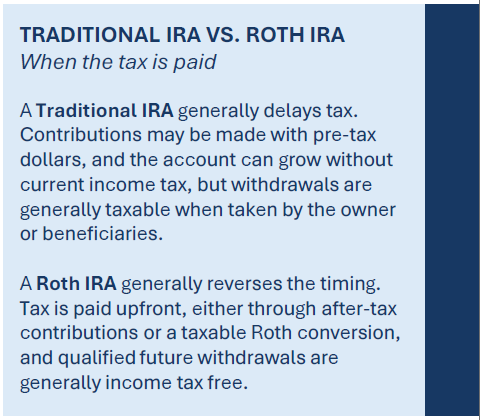
Traditional retirement accounts and Roth accounts do not merely represent different tax labels. They create different planning dynamics. Traditional accounts defer taxation but preserve a future income-tax liability that may surface through withdrawals, required minimum distributions or inherited-account rules. Roth assets reverse the timing: tax is generally paid on the taxable portion at conversion, while qualified future withdrawals may be income-tax-free and more flexible.
For many households, that flexibility matters as much as the tax rate itself. A Roth IRA owner is not subject to lifetime required minimum distributions, which can allow assets that are not needed for spending to remain invested and continue compounding. Qualified withdrawals are income-tax-free, which can support better bracket management later in life, especially when other income sources such as Social Security, pensions, business income or portfolio income already use much of the household's lower tax-bracket capacity.
This is the central strategic appeal of a Roth conversion: not simply the potential for tax-free qualified withdrawals, but greater tax diversification and the ability to reduce future forced income and manage taxable income more deliberately over time.
Where Conversions Can Add Real Value
The most attractive Roth conversion opportunities usually arise during temporary planning windows rather than permanent conditions. A retirement transition, a temporary decline in earned or business income, a year with unusually large deductions or the years before required minimum distributions begin can create such a window. Income may temporarily decline, while future required distributions have not yet begun. That gap can create room to recognize income at relatively manageable marginal rates.
Market drawdowns can create another opening. When asset values are temporarily depressed, a conversion provides an opportunity to recognize tax on reduced values and potentially affords a future recovery of values in a Roth structure for the same current tax cost. The benefit here is not market timing in a speculative sense. It is recognizing that the tax is imposed on current value, while the subsequent rebound, if it occurs, takes place inside the Roth.
Estate planning can also strengthen the case. Under current U.S. rules, many non-spouse beneficiaries must distribute inherited retirement accounts within 10 years, although exceptions apply. A Roth conversion does not eliminate that distribution timetable, but it can materially improve the tax character of those withdrawals. For families likely to leave retirement assets to heirs in highearning years, shifting part of the tax burden to the older generation may improve after-tax wealth across the family balance sheet.
This broader planning perspective is not limited to children or other heirs. It may also matter for a surviving spouse, who could face higher taxes after the first spouse’s death. Converting some assets to a Roth IRA while both spouses are living can provide more flexibility before that change occurs. Roth assets can also serve as a reserve for later years, available if needed, but often valuable to preserve while the family continues to consider future income needs, taxes and estate planning goals.
This can become even more relevant in advanced estate planning. In some structures, a Roth IRA may be an attractive asset to direct to a properly drafted generation-skipping transfer (GST) tax-exempt trust or other long-duration family trust because qualified distributions are generally income-tax-free. Subject to the trust qualifying under the applicable beneficiary rules, the inherited Roth may continue compounding during the 10-year payout window without the same annual income-tax drag that could apply to a traditional IRA. That is also why Roth assets are often among the last dollars a household may choose to spend during life: if other assets are available for current cash-flow needs, preserving the Roth may retain tax-efficient optionality for heirs and other beneficiaries. The conversion itself does not remove the IRA from the owner's estate, but it may improve the income-tax character of assets that remain available for the family or ultimately pass to a trust. Trust-based strategies should be reviewed with estate and tax counsel.
Why Partial Conversions Often Work Better Than Large Ones
In practice, the strongest Roth conversion strategies are usually incremental. The goal is rarely to convert everything at once. More often, it is to convert enough each year to use available tax capacity without moving the household into a less favorable effective tax range or triggering avoidable secondary costs.
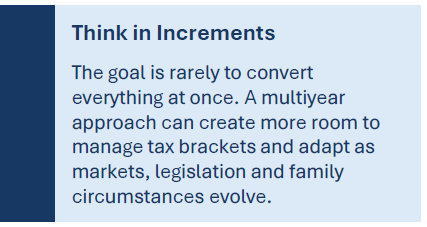
That requires careful sizing. A well-executed multiyear conversion plan can use lower-bracket capacity, manage interactions with capital gains or business income and adapt as markets, legislation and family circumstances evolve. By contrast, a one-time large conversion can materially reduce its expected benefit if the effective tax cost rises sharply.
This is one reason the framing matters. Roth conversions are not about being "for" or "against" Roth assets. They are about deciding how much income should be recognized, in which year and at what price.
Implementation Details That Can Change the Result
This is where a conversion analysis can become too simplified if it focuses only on the headline tax rate. The immediate tax bill is only the starting point. Several implementation details can materially change the result.
The source of the tax payment matters.
In general, the economics are better when the tax is paid from assets outside the retirement account rather than from the IRA itself. For households with taxable estates, an external tax payment can also reduce assets that may otherwise remain subject to estate tax, so the conversion should be evaluated on a combined income- and transfer-tax basis rather than on the income-tax bill alone. Using retirement assets to pay the tax shrinks the amount that remains invested in the tax-advantaged structure and can reduce the long-term benefit of the conversion. The implementation plan should also account for any withholding or estimated tax payments that may be required.
After-tax basis must be handled correctly.
Households with nondeductible IRA contributions need accurate records because the applicable tax rules may cause the taxable portion of a conversion to differ from the gross amount converted. If basis records are incomplete, the analysis can be wrong before the strategy begins.
Conversions can create secondary effects that have little to do with the stated marginal bracket.
Higher income in a conversion year can increase the taxation of Social Security benefits, raise Medicare premiums in later years and affect other income-sensitive deductions, credits or surtaxes. The nominal bracket alone is not the whole story.
Conversions are generally not reversible.
Once income is recognized, the household cannot simply unwind the transaction because markets fall or the tax cost later looks unattractive. That makes sizing, timing and execution discipline especially important.
The Roth label should not be treated as universally simple.
Separate five-year rules may apply to qualified distributions and converted amounts. For clients converting later in life or planning near-term withdrawals, those rules deserve explicit review before assuming every future distribution will be tax-free.
When the Math Can Break Down
Roth conversions are easy to oversell because the strategic logic is appealing. But there are clear situations in which the math becomes less favorable.
A conversion may be less attractive when a household expects to be in a meaningfully lower tax bracket later, when the assets will likely be spent quickly, or when there is not enough non-retirement liquidity available to pay the tax efficiently. It can also be less appealing for charitably inclined clients. Traditional IRA assets can be particularly valuable in charitable planning because, for eligible clients, qualified charitable distributions can move money directly from an IRA to charity without adding the qualifying amount to taxable income. Traditional IRA assets can also be used for charitable gifts or bequests at death. In those cases, preserving some traditional IRA balance may be more efficient than converting aggressively.
State taxation can also influence the result. A household planning to relocate from a high-tax state to a lower-tax jurisdiction, or vice versa, may face a very different answer depending on where the income is recognized. The conversion decision is therefore not only about federal tax rates; it is also about geography, timing and expected cash-flow needs.
California is a useful illustration. California generally taxes residents on income from all sources, while nonresidents generally are not subject to California tax on qualifying retirement income such as IRA distributions and Roth conversions. That means the same conversion can produce a different after-tax result depending on whether it is executed before or after a move. State law and residency should be confirmed before implementation.
The point can become even more important in cross-state families. A parent living in a low- or no-tax state may choose to recognize federal income tax through a conversion, potentially reducing or eliminating state tax that could otherwise apply to a child's future taxable inherited-account distributions. Whether that improves the family's overall result depends on the federal and state tax profiles of both generations.
A Global Lens on a Seemingly American Topic
Roth conversions are specific to the U.S. tax code, but the underlying planning problem is global. Across retirement systems, households often face some version of the same choice: receive tax relief now, or preserve greater tax-free flexibility later.
Canada offers a close conceptual parallel. The Registered Retirement Savings Plan favors deduction now and taxation later, while the Tax-Free Savings Account forgoes the upfront deduction but provides tax-free growth and withdrawals. The United Kingdom presents a different mix, where pension contributions receive tax relief but non-pension wrappers such as ISAs provide tax-free investment flexibility. Australia's superannuation system introduces its own structure, with tax consequences spread across contribution, accumulation and retirement phases.
These systems are not interchangeable, and none maps perfectly onto a Roth conversion. But they all point to the same strategic question: when should income be recognized, at what tax cost and how much control should the investor retain over future withdrawals?
That broader lens is especially relevant for globally mobile families. A Roth IRA's favorable U.S. treatment does not automatically travel across borders unchanged. Residence, treaty elections and local tax law can all alter the outcome. For internationally connected households, the analysis has to extend beyond the U.S. return.
Closing Thoughts: The Better Framing
A Roth conversion is not a default strategy, and it is not a referendum on whether taxes are destined to rise. It is an opportunistic planning lever that can reshape future taxable income, reduce forced distributions, improve estate outcomes and increase flexibility for households that can afford the upfront cost.
That is what makes the decision important. The question is not whether Roth is better in the abstract. The question is whether prepaying tax today buys something valuable enough in return: more control, greater tax flexibility, more favorable after-tax compounding or a more tax-efficient transfer of wealth.
For the right household, that exchange can be well justified. For the wrong one, it simply accelerates tax. The difference lies in the details: timing, bracket management, liquidity, charitable intent, geographic considerations and the discipline to size the conversion within the broader plan. The practical next step is to model several conversion amounts rather than treating the decision as all or nothing and coordinate the analysis with the household's tax, investment, cash-flow, charitable and estate planning.
Disclosures
The views expressed are those of Brown Advisory as of the date referenced and are subject to change at any time based on market or other conditions. These views are not intended to be and should not be relied upon as investment advice and are not intended to be a forecast of future events or a guarantee of future results. Past performance is not a guarantee of future performance and you may not get back the amount invested.
Any accounting, business or tax discussion contained in this communication is not intended as a thorough, in-depth analysis of specific issues, nor a substitute for a formal opinion, nor is it sufficient to avoid tax-related penalties. Prior to making an investment decision, a prospective investor should consult with their own legal, tax, accounting and other advisors to determine the potential benefits, burdens and other consequences of such investment. This piece is intended solely for our clients and prospective clients, is for informational purposes only and is not individually tailored for or directed to any particular client or prospective client.