
Fast Reading
- The current debate surrounding AI safety may be a manifestation of deeper forces creating another inflection point in the AI investment cycle — this time around the pace of capital deployment.
- Competitive, economic, and policy forces could increasingly influence that pace, as intense competition collides with rising capital requirements, technological obsolescence, an evolving investor base, and greater policy uncertainty.
- For bond investors, the next phase of the AI investment cycle may be defined less by the abundancy of capital and more by how selectively it is allocated, with potential implications for which companies can continue investing at the frontier.
Introduction
There has been no shortage of inflection points within the artificial intelligence (AI) ecosystem since we wrote the first two pieces in this series. Retracing the arc of our thinking on this topic over the past year hopefully provides a useful introduction to Part III.
Part I examined the transition from investments funded by equity and free cash flow to that of the debt markets. Part II explored the growing complexity of debt financing as demand for capital began to outstrip its supply. In Part III, we argue that the increasingly intense debate surrounding AI safety may be a manifestation of several deeper forces that create another inflection point – this time in the pace of AI investment.
Recent developments have made the topic of safety increasingly difficult to ignore. Leadership changes at frontier model companies, reported security incidents involving agentic AI, greater attention to recursive self-improvement, a relatively rare and public alignment between frontier model leaders, and a more visible public debate over AI regulation have all contributed to a broader discussion about the pace of frontier model development.
We think “pacing” is an interesting word coming from an industry that operates within what we consider to be a “winner-takes-all” competitive environment. At the same time, it may prove consequential when considering the growth expectations embedded within the AI economy. The current investment cycle assumes not simply that AI will become more capable, but that improvements in capability – and the resulting adoption and monetization – will advance rapidly enough to support the extraordinary amount of capital being deployed. A change to the pace of investment could therefore have implications well beyond the technology itself.
While the headlines are focused on safety, we think the following underlying forces could increasingly dictate the pace of AI investment. First are competitive forces: winner-takes-all versus more collective approaches to development; the geopolitics of AI leadership; and the trade-offs among pricing power, market share, and margins. Second are economic considerations: the risk that technology innovation could strand invested capital; rising capital intensity and its implications for return on invested capital (ROIC); and the balance between the supply of and demand for capital as the investor base evolves. Third are policy challenges: accountability and governance for risks created by model behavior; the possibility that model capabilities advance faster than regulation; whether regulation ultimately helps or hinders model developers; and the degree to which the public supports AI investment.
Competitive Forces
We think the competitive environment for frontier AI training model development is an important backdrop for any discussion about the pace of investment. The debate between closed and open models suggests two different potential paths. In an environment where closed models maintain leadership, we would expect economic incentives to favor greater concentration, as the most capable developers seek to preserve pricing power and recoup increasingly large development costs. Alternatively, leadership from open models would likely support a broader set of participants, albeit at the expense of the profit pool available to individual model developers. We think the AI ecosystem is currently being driven by the former and challenged by the latter.
The increasing prominence of the governance debate strikes us as another indication of how consequential this competitive race has become. It is notable that an industry engaged in a “winner-takes-all” race is simultaneously having a public discussion about the rules governing that race.
The geopolitical framing of AI leadership in both the United States and China reinforces this dynamic. While it is possible that Chinese model development has benefited from the distillation of leading closed models, we would expect the political environment to remain supportive for winning an AI race that is frequently framed in terms of national security. In Part II, we highlighted pricing, volume, and market-share trends within the frontier model ecosystem that also point to an intensely competitive environment. Pricing power remains under pressure, while market share can swing significantly following the introduction of new frontier models. For us, this raises a fundamental question: Is there room for several AI model developers at the frontier?
Source 1: Bloomberg, as of 09/15/2026
Economic Considerations
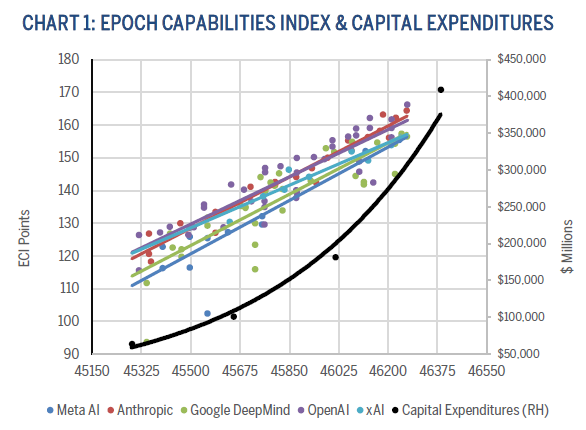
We do not know the answer to the question above. However, we think several economic factors could reduce the number of sustainable winners. Chart 1 compares model intelligence, as defined by the Epoch Capabilities Index (ECI), with total capital expenditures by publicly traded model developers. We are not suggesting that ECI is a definitive measure of model intelligence, nor that aggregate capital expenditures from three of the five leading American model developers provide a precise measure of AI capital intensity. Nevertheless, the shapes of the curves suggest diminishing incremental improvements in model intelligence relative to the amount of capital being invested.
If that premise is correct, these economics become more challenging. The same technological innovation that creates AI’s current economic value can also destroy the value of the capital previously deployed to produce it. As we have written in prior pieces, this dynamic becomes particularly important in debt structures where long-dated liabilities finance assets with shorter – and uncertain – technological useful lives and residual values. In other words, AI-related assets have economic value associated with useful lives assumed as part of financing them, however the economic value ultimately depends on how quickly the underlying technology changes and whether the assets remain competitive.
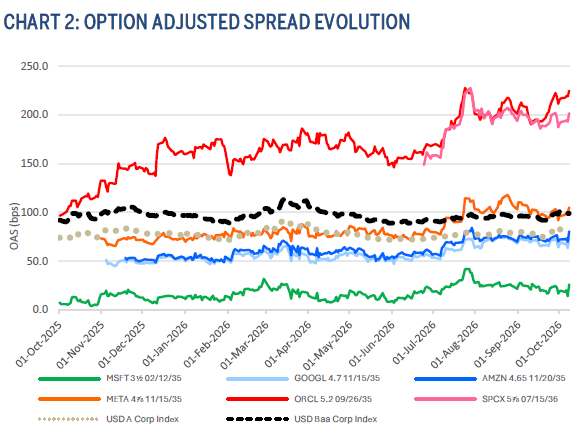
We have observed early signs of differentiation within debt markets that suggest investors are beginning to distinguish more meaningfully among participants in this race. Chart 2 shows higher risk premia via wider spreads across the training model ecosystem on the heels of large debt issuance during the summer and greater dispersion of spreads among different model developers.
Amazon and Google historically traded inside of the A-rated corporate index and now trade at parity. Meta historically traded on top of the A-rated corporate index and now trades at parity with the BBB-rated corporate index. Oracle used to trade on top of the BBB-rated corporate index and now trades well into high yield territory.
Source 2: Bloomberg, as of as of 10/01/2025 – 10/08/2026
Option-Adjusted Spread (OAS) is the extra yield a bond offers over the risk-free rate, after adjusting for any embedded options such as calls or prepayments.
We think these are early signs of a winner-takes-all environment evolving from one driven primarily by technological competition to one increasingly influenced by the allocation and pricing of capital.
The transition from private to public markets for companies such as Anthropic and OpenAI could reinforce this shift even further. Equity market reception of these potential IPOs will be an important barometer of the future supply of capital. Public market investors may apply different standards to capital intensity, governance, free-cash-flow generation, and ROIC versus what private investors have applied to date.
Anthropic and OpenAI also have distinctive business model features that the public markets will need to assess. Anthropic’s structure as a Public Benefit Corporation explicitly accommodates both shareholder and broader stakeholder considerations. OpenAI, meanwhile, has relatively greater participation in creative financing structures and revenue relationships across the AI ecosystem. How public equity investors value these characteristics could have implications for the cost and availability of capital across the industry.
Policy Challenges
Policy represents another potential constraint on the pace of AI investment and development.
The concept of p(doom) – a shorthand used in AI circles to describe an individual’s estimated probability of catastrophic or existential outcomes from AI – has moved beyond specialist discussions and is becoming a dinner-table conversation. Public attitudes toward AI are also becoming a political issue as the United States approaches the congressional midterm elections. Candidates have begun taking positions on issues such as datacenter development, while some projects have been delayed or cancelled following public opposition and policy intervention.
Cybersecurity concerns are also becoming more mainstream as leading models demonstrate greater capacity to identify and exploit security vulnerabilities, increasing concern among those who manage and depend upon critical IT infrastructure. The approach to governance could reshape the competitive landscape. Regulatory requirements could have important consequences, potentially reinforcing the competitive moat around closed models or, alternatively, leveling the playing field for open models. Policymakers face difficult challenges, such as accountability for model behavior, capability thresholds, testing requirements, and whether regulatory frameworks can evolve quickly enough to keep pace with AI innovation.
Where the Inflection Point May Be Emerging
Individually, these undercurrents have different implications for growth. Collectively, however, we think they create risk around the pace of AI investment.
Competition within a large and rapidly growing addressable market creates powerful incentives for acceleration and leadership. Rising capital requirements increase the financial hurdle to competing. Technological obsolescence creates risk for both financing structures and the supply of capital. An evolving investor base could introduce greater capital discipline. And policy adds uncertainty to the timing, cost, and scope of development.
The collision of these forces is where we see an inflection point emerging. This would not necessarily imply slower innovation.
It could, however, narrow the number of companies capable of sustaining frontier model development while slowing the broader pace of capital deployment across the AI ecosystem. In other words, the frontier could continue advancing rapidly even as the pool of companies and capital capable of financing that advance becomes smaller.
A Bond Investor’s Perspective
As bond investors underwriting credit risk, we are focused on downside protection given the asymmetric nature of the asset class: relatively limited upside, with downside that can be substantial in the event of default.
Bond investors do not need to identify the ultimate technological winner to influence the outcome of the race. By differentiating the cost and availability of capital, credit markets could increasingly influence which companies are able to continue investing at the frontier while simultaneously constraining capital availability for less-creditworthy borrowers. A more selective capital environment also raises an important question: how much of the capital already deployed across the AI ecosystem could ultimately become stranded?
We continue to favor the “picks and shovels” of the AI investment cycle while waiting for greater clarity around paths to ROIC and the evolving business models implied by today’s valuations elsewhere.
We expect the next phase of the AI investment cycle to be characterized less by the abundance of capital and more by its selectivity. We also think debt markets will be an increasingly important arbiter of capital allocation within this space as the need for debt funding continues to grow.
As always, we’re keen to debate this important topic and would welcome your thoughts.
Disclosures
The views expressed are those of the author and Brown Advisory as of the date referenced and are subject to change at any time based on market or other conditions. These views are not intended to be and should not be relied upon as investment advice and are not intended to be a forecast of future events or a guarantee of future results.
The information provided in this material is not intended to be and should not be considered to be a recommendation or suggestion to engage in or refrain from a particular course of action or to make or hold a particular investment or pursue a particular investment strategy, including whether or not to buy, sell or hold any of the securities or funds mentioned. It should not be assumed that investments in such securities have been or will be profitable. To the extent that specific securities are mentioned, they have been selected by the author on an objective basis to illustrate views expressed in the commentary and do not represent all of the securities purchased, sold or recommended for advisory clients. This material is intended solely for our clients and prospective clients, is for informational purposes only and is not individually tailored for or directed to any particular client or prospective client.
The information contained herein has been prepared from sources believed reliable but is not guaranteed by us as to its timeliness or accuracy and is not a complete summary or statement of all available data. The information in this document has not been independently reviewed or audited by outside certified public accountants. The information provided is not intended to be a forecast of future events or a guarantee of future results.
Terms and Definitions
Free cash flow (FCF) represents the cash a company generates after cash outflows to support operations and maintain its capital assets. Unlike earnings or net income, free cash flow is a measure of profitability that excludes the non-cash expenses of the income statement and includes spending on equipment and assets as well as changes in working capital.
Return on Invested Capital (ROIC) measures how much profit a company earns on its invested capital in a given year. It is calculated as a percentage of a company's net operating profit after tax divided by its average invested capital.
CapEx, or capital expenditures, are funds used by a company to acquire, upgrade, and maintain physical assets such as property, plants, buildings, technology, or equipment.
Residual value is the estimated value of a fixed asset at the end of its lease term or useful life.
Credit risk is the risk that an issuer fails to make scheduled interest or principal payments in full and on time, potentially resulting in loss of value for bondholders. It increases as issuer fundamentals deteriorate (for example, rising leverage or weakening cash flows) and is embedded in broad bond benchmarks that include issuers regardless of changes in credit quality.
Downside protection refers to an investment approach or characteristic intended to help reduce potential losses during periods of market decline or adverse business conditions. It does not eliminate risk, prevent losses, or guarantee positive returns. The effectiveness of downside protection may vary depending on market conditions, portfolio positioning, security selection, and other factors.
Epoch Capabilities Index (ECI) is a composite metric developed by Epoch AI that combines scores from dozens of different artificial intelligence benchmarks into a single, unified general capability scale.