
Fast Reading
- Today’s most visible AI beneficiaries are infrastructure providers, but long-term value may accrue to a broader, less obvious group of companies.
- Some companies viewed as vulnerable to AI disruption may instead use AI to strengthen their economics, improve productivity, deepen customer relationships or create new revenue streams.
- Valuation remains critical, as technological revolutions do not always reward the companies that appear to be the most obvious early beneficiaries.
Investors have spent much of this year trying to understand how artificial intelligence (AI) will reshape markets and which companies are most likely to benefit over time.
There seems to be no debate that AI matters, but the more interesting question is how investors should attempt to profit from it.
So far, the market’s answer has appeared relatively straightforward. Semiconductor businesses, data centre infrastructure providers, and the wider AI ecosystem have become the clearest and most visible beneficiaries of the enormous capital expenditure cycle currently underway. A small number of companies have added hundreds of billions, and in some cases trillions, of dollars in market value in a remarkably short period of time.
To some extent, this makes perfect sense. AI is likely to be an enduring technological theme, and investors understandably want exposure to what may prove to be one of the defining economic shifts of the coming decades.
However, we think there is an important distinction between the short-term winners from today’s AI investment cycle and the businesses that may ultimately capture the long-term economic value it creates. And that distinction matters enormously.
The obvious winners may not be the only winners
One particularly interesting aspect of the current cycle is the way AI winners increasingly affect the structure of markets themselves. Once a company enters the trillion-dollar club, ownership can quickly cease to be an active decision. A significant portion of global equity assets are now managed passively or relative to a benchmark, increasing the influence of index-driven capital flows. As these businesses rise, passive vehicles are forced buyers irrespective of valuation. This creates a reflexive dynamic where rising share prices attract more capital, which in turn supports even higher valuations.
Perhaps those valuations will ultimately prove justified. But history suggests investors should remain cautious whenever markets begin extrapolating extraordinary current conditions far into the future.
The result today is that many investors feel caught in an uncomfortable position. They are nervous about chasing AI infrastructure stocks higher, but equally nervous about missing the AI revolution altogether. That has led to a scramble to identify second- and third-order beneficiaries: businesses exposed to power infrastructure, cooling systems, networking equipment, and other adjacent areas.
Again, this is understandable. But we suspect the market is already becoming highly efficient at identifying and pricing these obvious beneficiaries. They, like semiconductor stocks, can continue to move much higher, but as increasingly aggressive assumptions become embedded in valuations, the balance of risks can quickly shift out of investors’ favour.
Micron Technology, a semiconductor company producing memory and data storage solutions, provides an interesting illustration. Just 12 months ago (August 2025), earnings per share were approximately $7.501. Today, investors are contemplating a world in which 12 months from now, many analysts expect earnings per share to be 20x higher than that level, supported by surging demand for AI-related memory products1. At the same time, many investors argue for the market to assign higher multiples to those earnings on the basis that they may prove more durable than in previous cycles.
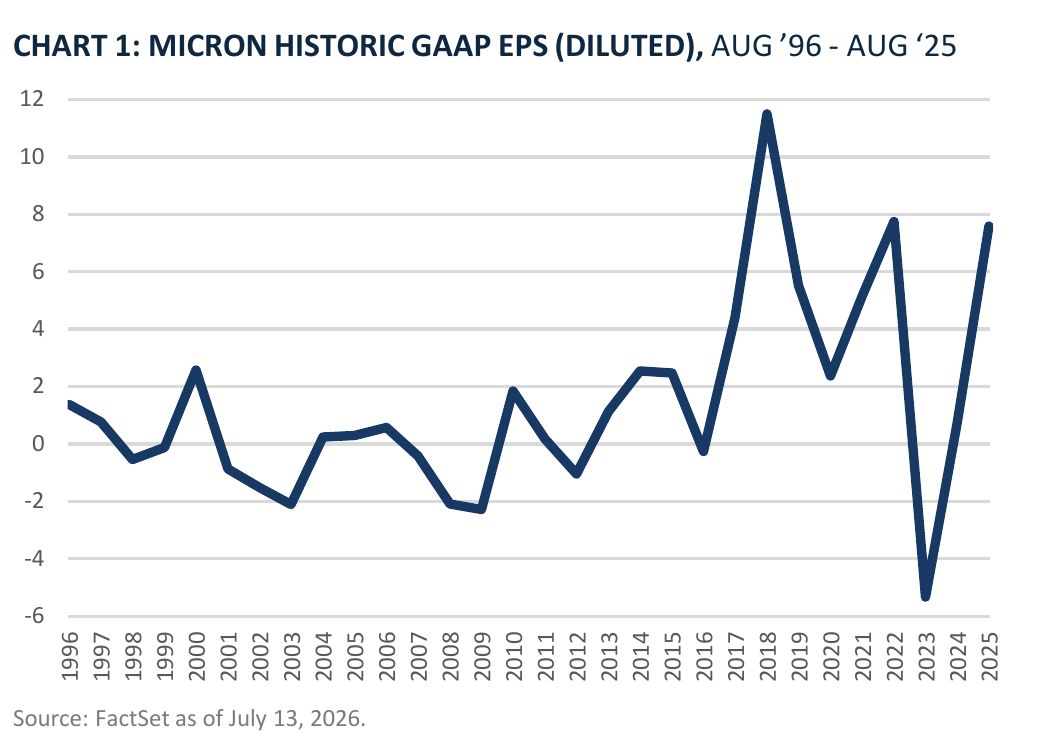
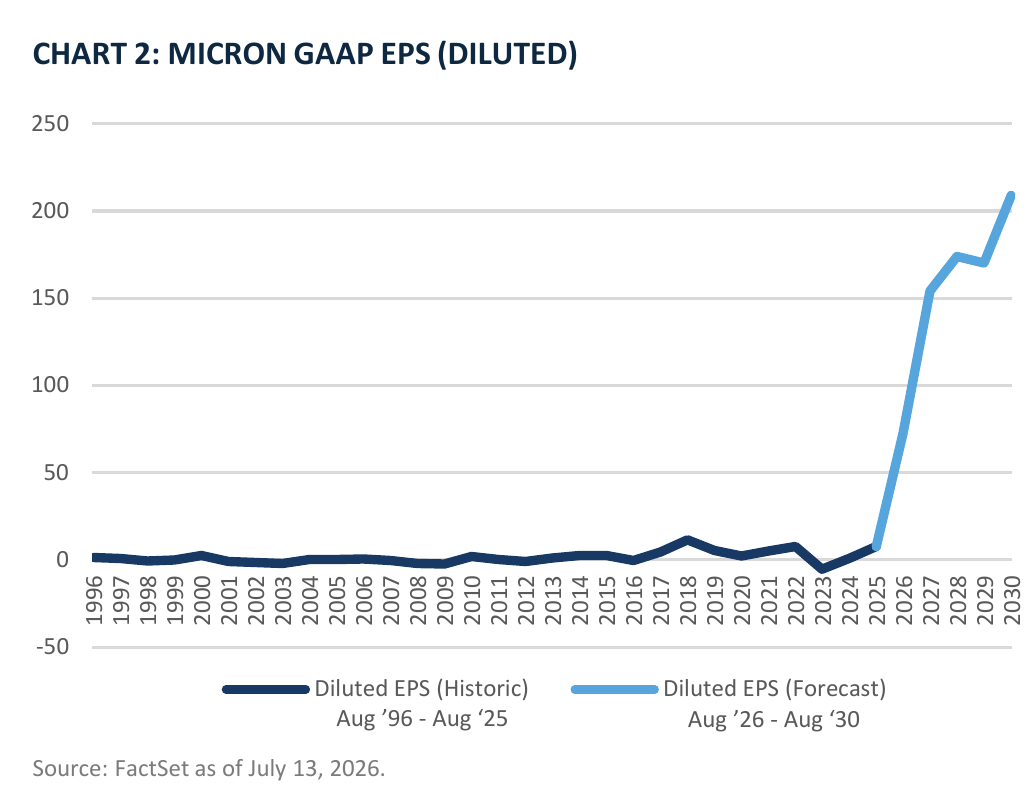
That combination of rising earnings and expanding valuation multiples is powerful and has helped to explain how certain AI beneficiaries have generated such exceptional returns. Over recent weeks we’ve seen a shift in market sentiment which, in Micron’s case, has reversed the movement in multiple and led to a significant de-rating. However, the key issue remains: how much of the future benefit from AI is already reflected in current expectations, and how durable will those earnings ultimately prove to be?
When disruption reinforces advantage
What strikes us as more interesting is the market’s treatment of businesses that may ultimately use AI, or deliver AI-enabled solutions, rather than primarily supplying the infrastructure behind it.
In many cases, the market appears remarkably willing to assign positive value to businesses building AI infrastructure while simultaneously assigning negative value to businesses expected to be disrupted by AI. Across Software, Information Services, Financials, Payments, and numerous other sectors2, many companies now trade under a cloud of perceived AI risk. Investors worry that automation or generative AI may compress pricing, reduce demand, or undermine incumbent business models.
In some cases, those fears may prove justified. But in many others, we believe the market may be underestimating the extent to which AI could enhance incumbent economics rather than destroy them.
“One of our observations from more than two decades of investing is that opportunity and threat are frequently two sides of the same coin.”
The very developments that investors fear may disrupt an industry can often strengthen the position of the best businesses within it. New technologies rarely affect all participants equally. Strong incumbents frequently find ways to adapt, incorporate change and deepen their competitive advantages, while weaker competitors struggle.
Importantly, we are already beginning to see evidence of this.
S&P Global, a company many investors once viewed as directly exposed to AI disruption, recently disclosed that during current contract renewals it is achieving pricing premiums of roughly 35–45% for AI-ready datasets and enhanced analytical offerings3. Far from being a disruptor, agentic developments appear to be reinforcing many of the natural advantages of the company’s business model.
Despite these positive developments, S&P continues to trade at a valuation that may be challenging for some value-oriented investors to justify given that it already reflects many of its longstanding advantages. But not every opportunity requires that leap of valuation faith.
Salesforce provides another useful example. Critics often point out that if one strips out acquisitions and the contribution from newer AI-related products, the underlying growth profile of the business appears relatively stable rather than spectacular. That observation is not entirely wrong. However, excluding one of the most important developments affecting the business may provide an incomplete picture of its economic prospects.
If AI products are generating demand, improving customer engagement and creating new revenue streams, they are not a temporary accounting adjustment; they are part of the economic reality of the business. To us, this feels somewhat analogous to analysing Ryanair’s underlying ticket prices, for example, while ignoring ancillary revenues. Whilst the underlying metric may be interesting, it is not how customers experience the product or how shareholders ultimately earn their returns.
So far, the evidence suggests that Salesforce is successfully capturing value from AI adoption.
These examples matter because they suggest that AI may not commoditize existing businesses. In some cases, it could strengthen them.
We’ve picked two companies here which both have business-to-business (B2B) business models. This is not a coincidence and reflects our belief that these companies may be better positioned to navigate the AI transition as opposed to many business-to-consumer (B2C) alternatives. Whilst we cannot know whether this will prove true, our judgement is informed by our understanding of human behaviour — a constant focus for value investors.
Our observation would be that consumers can be fickle. They can be quick to adopt new products, but equally quick to abandon them if a cheaper or marginally better alternative emerges. This behaviour makes complete sense, but it means transitions can be swift and unpredictable, particularly in low-value or commoditised categories.
But enterprise purchasing decisions can be very different.
If a business is selecting a gardener to maintain the grounds outside its office, finding the lowest-cost reasonable provider may be perfectly rational. However, purchasing a customer relationship management platform to store, protect and analyse the entirety of a company’s customer data is a very different choice.
A customer relationship management (CRM) system sits at the centre of a company’s operations. It stores customer relationships, workflow histories, operational data and sales processes. Replacing it involves disruption, retraining, integration risk and potential operational failure. Businesses making these decisions are not simply optimising for lowest cost. They are considering trust, continuity, reliability, accountability and long-term strategic value. Trusted providers, with broad capabilities and deep integrations, become important. Price matters, but it is far from the only consideration.
Another crucial factor in B2B purchases is the human element. As purchases become more expensive and more integral to an organisation, decision-making tends to involve more humans, not fewer. Buying a bag of chips doesn’t require sales advice. Buying a car, a house, a private equity portfolio or a multi-million-dollar CRM implementation often does.
That matters because human involvement creates stickiness: it creates inertia, reinforces the status quo, and builds trust networks that are difficult to displace.
This is one reason we believe certain enterprise software and information businesses may prove more resilient in an AI-enabled world than current valuations imply. In many cases, these businesses already occupy trusted positions within customer workflows. AI may not displace that position so much as enhance it, allowing incumbents to deepen integration, improve productivity and potentially charge more for higher-value services, whether developed internally or delivered alongside trusted partners.
It’s not just about probability, it’s about payoff
More broadly, we suspect market participants may be making the classic mistake of focusing heavily on the probability of disruption while paying far less attention to the payoff profile if prevailing assumptions turn out to be right or wrong.
This is a common behavioural error. Investors spend enormous amounts of time debating whether something might happen, but much less time considering what the consequences would be if it did.
Today, many businesses are already priced as though AI will materially impair their economics. But what happens if AI instead lowers operating costs, improves productivity, expands margins or strengthens customer relationships?
The upside in these situations can be significant because not only does the valuation discount disappear, but earnings themselves may subsequently grow while the market simultaneously re-rates the multiple attached to those earnings.
That combination — earnings growth and multiple expansion — is where some of the most powerful long-term equity returns are generated.
None of this is intended to suggest semiconductor businesses or AI infrastructure providers are poor businesses. Many are high-quality companies. But good businesses do not always make good investments, when expectations are already embedded in their prices.
History repeatedly demonstrates that technological revolutions create enormous value for society, while not always creating equivalent value for shareholders who arrive late or pay excessive prices. Railways, telecom infrastructure, fibre optics and early internet hardware all transformed economies, but long-term shareholder returns varied enormously depending on valuation and competitive intensity.
We suspect AI may ultimately prove similar. The long-term winners economically may not necessarily be the same as the short-term market winners.
Although we believe there are numerous situations where AI pessimism may be creating attractive opportunities, we remain very conscious of concentration risk. No thematic, irrespective of conviction, should become the sole driver of a portfolio.
Today, around 20% of the Global Value Select Strategy and around 15% of the International Value Select Strategy have exposure to businesses where AI concerns form at least part of the negative narrative surrounding the shares4. In some cases, AI is only a secondary concern. In others, investors view the threat as potentially existential.
We monitor this exposure carefully. The goal is not to build an “AI portfolio”, but to identify situations where expectations appear excessively pessimistic relative to probable long-term outcomes.
Expectations matter
Recently, a client asked whether we would be satisfied if our portfolios generated a hypothetical 15% internal rate of return (IRR) over the next decade. Our answer was simple: absolutely.
The client then asked whether we would still be satisfied if the broader market produced a hypothetical 20% annualised return over the same period5.
Truthfully, we would.
Investing is not about perfectly maximising every possible outcome in hindsight. It is about allocating capital intelligently under uncertainty. A 15% annualised return over a decade would represent an exceptional long-term outcome by almost any historical standard and a result we would be pleased to achieve for our clients and for ourselves, as we invest alongside them.
Could markets do even better? Possibly. Could the current AI leaders continue compounding far beyond current expectations? Perhaps. But investing successfully does not require capturing every fashionable theme at any price. It requires understanding expectations, behaviour, valuation and asymmetry.
Today, much of the market appears willing to capitalise AI infrastructure companies’ earnings as though they are structurally durable far into the future, while many incumbent businesses are still valued as though AI represents principally a threat to their existence rather than a tool that may enhance their economics.
History suggests technological revolutions rarely distribute value in the way markets initially expect.
As value investors, that asymmetry is where our interest lies.
- Source: FactSet as of July 13, 2026.
- Sectors are based on the Global Industry Classification Standard (GICS®) and “GICS” are service marks/trademarks of MSCI and Standard & Poor’s.
- Source: S&P Global, First Quarter 2026 Earnings Conference Call, April 28, 2026.
- Source: FactSet as of 6/30/2026. Portfolio level information is based on representative Global Value Select and International Value Select accounts.
- The return figures discussed above are hypothetical and are provided solely for illustrative purposes to explain our investment philosophy. They do not represent expected or projected returns for any Brown Advisory portfolio or investment strategy and should not be interpreted as a prediction of future performance. Any forward-looking statements reflect current assumptions and expectations, are subject to change without notice, and actual results may differ materially due to market conditions, company-specific developments, and other factors.
Disclosures
All investments involve risk, including possible loss of principal. Please see each product’s web page for specific details regarding investment objective, risks, performance, and other important information. Review this information carefully before you make any investment decision.
The views expressed are those of the author and Brown Advisory as of the date referenced and are subject to change at any time based on market or other conditions. These views are not intended to be and should not be relied upon as investment advice and are not intended to be a forecast of future events or a guarantee of future results.
Past performance is not a guarantee of future performance, and you may not get back the amount invested.
The information provided in this material is not intended to be and should not be considered to be a recommendation or suggestion to engage in or refrain from a particular course of action or to make or hold a particular investment or pursue a particular investment strategy, including whether or not to buy, sell or hold any of the securities or funds mentioned. It should not be assumed that investments in such securities have been or will be profitable. To the extent that specific securities are mentioned, they have been selected by the author on an objective basis to illustrate views expressed in the commentary and do not represent all of the securities purchased, sold or recommended for advisory clients. This material is intended solely for our clients and prospective clients, is for informational purposes only and is not individually tailored for or directed to any particular client or prospective client.
The information contained herein has been prepared from sources believed reliable but is not guaranteed by us as to its timeliness or accuracy and is not a complete summary or statement of all available data. The information in this document has not been independently reviewed or audited by outside certified public accountants. The information provided is not intended to be a forecast of future events or a guarantee of future results. Past performance is not indicative of future performance.
Brown Advisory uses artificial intelligence (“AI”) tools to assist with analyzing and summarizing various data and information. All AI assisted outputs are reviewed and validated by the Brown Advisory Investment team, and these tools do not replace or inform the firm’s independent fundamental research or investment decision making. AI is not involved in the management of any Brown Advisory fund or strategy.
Terms and Definitions
Internal rate of return (IRR) is a measure of an investment’s rate of return. The internal rate of return is a discount rate that makes the net present value (NPV) of all cash flows from a particular project equal to zero. It is also called the discounted cash flow rate of return.
Earnings per share (EPS) is a measure of a company’s profitability, calculated by dividing quarterly or annual income (minus dividends) by the number of outstanding stock shares. The higher a company’s EPS, the greater the profit and value perceived by investors.
Diluted earnings per share (EPS) measures a company’s profit per share assuming all potential shares are issued, such as from stock options, warrants, convertible bonds, or convertible preferred stock.
GAAP Earnings per Share (EPS) is a measure of a company’s profitability, calculated in accordance with Generally Accepted Accounting Principles (GAAP) by dividing net income available to common shareholders by the weighted-average number of diluted shares outstanding during the reporting period. A higher GAAP EPS generally indicates stronger earnings attributable to each share of common stock.
FactSet® is a registered trademark of FactSet Research Systems, Inc.
Standard & Poor’s, S&P®, and S&P500® are registered trademarks of Standard & Poor’s Financial Services LLC (“S&P”), a subsidiary of S&P Global Inc.